How Trees Gossip in the Wind - A Whimsical Nature Story About Forests as Social Networks
Discover the secret social life of trees in this whimsical nature story exploring how forests communicate, share warnings, and “gossip” through wind and roots in a magical forest fantasy.
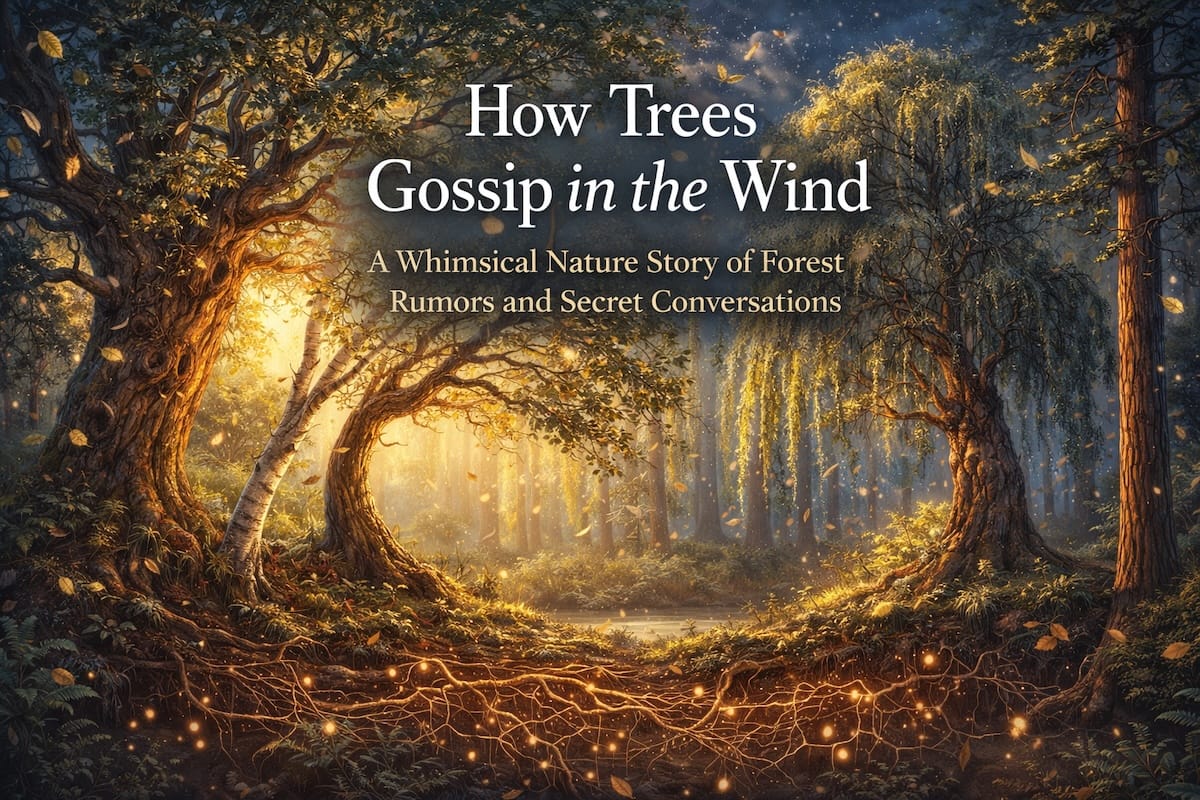
If you’ve ever stood in a forest on a breezy afternoon, you’ve heard it.
That soft, shifting murmur.
Leaves brushing against leaves.
Branches creaking like old wooden doors.
A ripple of sound moving through the canopy.
Most people call it wind.
But what if it’s conversation?
Not the sharp, hurried chatter of humans glued to screens. Not the loud, interrupting kind. Forest gossip is slower. Older. Patient. It moves in waves, not notifications.
Because here’s the thing: forests are not collections of individual trees.
They’re communities.
And like every community, they talk.
The Forest as a Social Network (Long Before Wi-Fi)
We love to think we invented networks. Social media. Connection platforms. Digital ecosystems.
Meanwhile, forests have been running a fully functioning communication system for millions of years.
Scientists call part of it the “wood wide web” — underground fungal networks that connect tree roots across vast areas. Through these networks, trees share nutrients, send chemical signals, and even warn each other about threats.
But let’s look at it through a more playful lens.
Imagine the forest as a neighborhood:
- The ancient oak is the respected elder.
- The birch trees are the quick-talking twins.
- The pine trees are quiet but observant.
- The willow? Dramatic. Always dramatic.
And beneath the soil, invisible threads connect them all — like group chats no human can access.
When one tree is attacked by insects, it releases chemical signals. Nearby trees receive the message and begin producing defensive compounds.
In human terms?
“Hey, something’s chewing on me. You might want to prepare.”
That’s not superstition.
That’s survival — with a hint of gossip.
Who Spreads the Rumors? (Hint: It’s Usually the Birch)
In every community, someone notices things first.
In forests, fast-growing species like birch or aspen often respond quickly to environmental changes. They’re sensitive. Reactive. Alert.
If the air shifts.
If insects arrive.
If drought creeps in.
They respond — and the message spreads.
Through roots. Through fungal networks. Through chemical exchanges.
Now, imagine it like this:
The birch rustles first.
“Something feels off.”
The wind carries the sound. Leaves tremble. A soft ripple passes through the canopy.
The older oak doesn’t react immediately. Oaks are patient. They’ve seen centuries of “something feels off.” But they listen.
Because even elders respect early warnings.
The Dramatic Willow (Every Forest Has One)
Let’s talk about the willow.
If trees had personalities — and for the sake of this whimsical nature story, they absolutely do — the willow would be the expressive one.
Leaning over rivers. Branches flowing like hair in a breeze. Swaying more than necessary.
Willows respond strongly to moisture levels and water movement. They thrive near streams, reacting visibly to changes in water flow.
So when a storm approaches, who starts moving first?
The willow.
It bends. It sways. It whispers loudly.
“Big rain coming. I can feel it in the roots.”
Other trees feel it too, but the willow makes a scene about it.
Every forest needs someone expressive. It keeps things interesting.
The Pine That Pretends Not to Listen
Now, the pines.
Tall. Straight. Needles instead of leaves. Minimal rustling compared to broadleaf trees.
They look detached. Aloof.
But don’t be fooled.
Pines communicate chemically just like other trees. When attacked by bark beetles, they release compounds that signal neighboring trees to increase resin production — a defense against infestation.
They don’t gossip loudly.
They send direct messages.
Think of the pine as the quiet group member who rarely speaks — but when they do, everyone pays attention.
The Underground Conversations We Never See
Here’s where the magical forest fantasy becomes scientific reality.
Beneath the soil, mycorrhizal fungi connect tree roots in vast networks. These fungal threads allow trees to:
- Share nutrients
- Send stress signals
- Support younger saplings
- Redirect carbon to struggling neighbors
Older trees — often called “mother trees” in forestry research — distribute nutrients to younger trees through these networks.
Imagine that.
The forest matriarch doesn’t just stand tall. She feeds the children.
In human terms, it’s less gossip and more group care. But messages still travel:
“This one needs help.”
“Shade here.”
“Drought coming.”
It’s not dramatic. It’s coordinated.
And it’s happening constantly.
What the Wind Actually Carries
Let’s return to the wind.
Wind isn’t just moving leaves. It carries scent. Moisture. Temperature shifts. Chemical traces released by plants.
When insects attack one tree, volatile organic compounds are released into the air. Nearby trees detect these airborne signals and prepare defenses.
So when you hear the leaves moving, imagine it like this:
The air itself is carrying whispers.
Warning. Adjustment. Awareness.
We hear rustling.
They hear meaning.
Seasonal Shifts: The Annual Forest Update
Every year, forests go through dramatic transformations.
Leaves turn. Sap slows. Growth pauses. Buds return.
But these shifts don’t happen randomly.
Trees track:
- Day length
- Temperature trends
- Soil moisture
- Sun angle
They prepare weeks before visible changes occur.
Imagine the forest in late summer.
The oak quietly murmurs: “Light’s changing.”
The maple responds: “Time to slow down.”
The birch already started preparing three days ago.
It’s less gossip, more collective calendar management.
No reminders needed.
Storm Warnings and Silent Agreements
Before storms, forests change.
Leaves flip to show pale undersides.
Branches stiffen.
Animals grow quiet.
Trees sense drops in barometric pressure and shifts in humidity.
Now imagine the scene:
The willow sways dramatically.
The birch rustles urgently.
The oak stands firm but alert.
The pine tightens its resin flow.
No shouting. No panic.
Just shared awareness.
Humans might call it eerie.
Trees call it Tuesday.
The Quiet Tree in the Corner
Every forest has one.
The tree that seems unnoticed. Not the tallest. Not the widest. Not dramatic. Not expressive.
But often, these are the connectors.
Research shows that certain trees act as hubs in underground networks — linking multiple species together.
They don’t make noise.
They facilitate.
In human social terms, they’re the ones who never post but somehow know everyone.
The quiet organizers. The steady roots.
Forests don’t just need personalities.
They need structure.
What Happens When a Tree Falls?
Here’s where the metaphor deepens.
When a tree falls, it’s not the end of its role.
Its roots decay slowly, feeding fungi. Its trunk becomes habitat. Its nutrients return to soil. Underground networks adjust.
Messages shift:
“Gap in the canopy.”
“More sunlight here.”
“Opportunity for growth.”
The forest doesn’t mourn the way we do — but it adapts.
Gossip becomes growth.
Change becomes space.
Is This Just Fantasy?
Let’s pause.
Are trees literally gossiping?
No.
But are they communicating?
Absolutely.
The idea of the forest as a social network isn’t just poetic. It’s supported by decades of ecological research into plant signaling and interdependence.
What makes it feel magical is how invisible it is.
We assume silence means absence.
But silence in forests is layered with information.
Why This Matters (Beyond the Whimsy)
There’s something deeply comforting about imagining trees as neighbors instead of objects.
When we see forests as communities:
We cut differently.
We conserve differently.
We respect differently.
Clear-cutting stops looking like lumber management and starts looking like erasing entire conversations.
Protecting forests becomes less about scenery and more about preserving living networks.
And maybe that shift in perspective is the real magic.
The Forest as a Mirror of Us
Here’s the part that sneaks up on you.
Human communities aren’t so different.
We send signals constantly:
Tone shifts.
Energy changes.
Silences that say more than words.
We’re wired for connection too.
But unlike trees, we’ve complicated it.
Forests communicate for survival and balance.
We often communicate for noise.
Maybe there’s something to learn from trees:
Speak when necessary.
Support the vulnerable.
Adapt to change.
Stay rooted, but connected.
The Next Time You Hear the Wind
Stand still.
Close your eyes.
Don’t think about emails. Or traffic. Or headlines.
Just listen.
The leaves brushing together. The low hum of branches. The shifting rhythm as wind moves through layers.
Imagine:
The birch sharing early warnings.
The willow exaggerating slightly.
The oak offering quiet stability.
The pine pretending it doesn’t care but caring deeply.
It may not be literal gossip.
But it is life responding to life.
And that’s far more interesting.
The Secret Life of Trees
Forests aren’t silent landscapes.
They are living conversations.
Through roots. Through air. Through chemical signals. Through seasonal rhythms.
When we describe it as gossip, we’re not diminishing science. We’re giving it personality — and sometimes personality helps us pay attention.
Because once you start seeing forests as communities instead of backgrounds, you don’t walk through them the same way.
You move slower.
You listen longer.
You notice who sways first when the wind picks up.
And maybe — just maybe — you realize the world has been talking all along.
We just forgot how to hear it.