If Rivers Had Personalities - A Fantasy About Rivers, Memory, and the Stories Water Keeps
What if rivers had personalities? Explore this whimsical fantasy about rivers through myth, nature, and magical water stories—where some flow patiently, some rage recklessly, and some never forget.
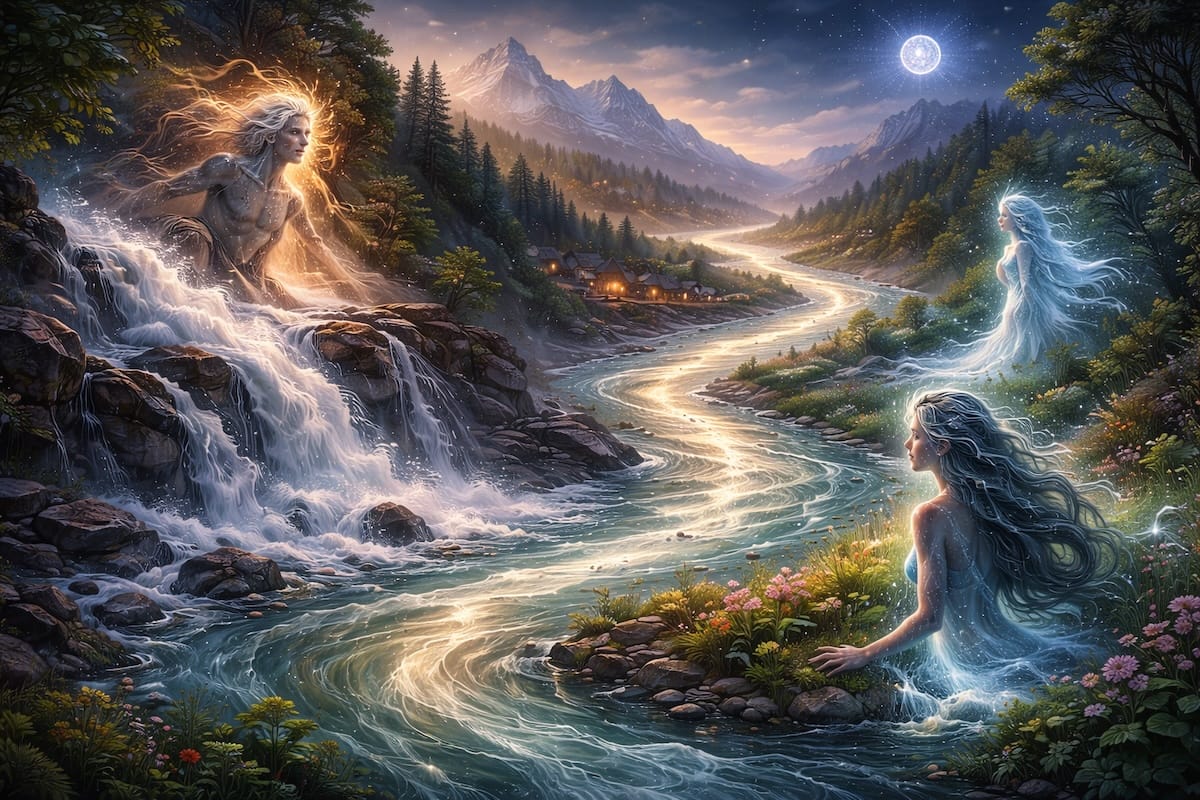
We talk about rivers as if they’re objects.
Water moving from point A to point B.
A resource. A boundary. A feature on a map.
But stand beside one long enough and you start to feel something else.
Some rivers rush past you like they’re late for something.
Some linger in wide bends, as if enjoying their own reflection.
Some carve canyons with quiet determination.
Some flood with dramatic fury.
What if rivers weren’t just flowing?
What if they had personalities?
Not cartoon faces or human voices — nothing that obvious. Something subtler. Something felt rather than seen.
Because if you’ve ever spent time by moving water, you already know: rivers behave differently.
And behavior, over time, begins to feel like character.
The Patient River
There’s always a patient one.
The river that winds through meadows without urgency. The one that accepts fallen branches without complaint. The one that moves steadily, season after season, never dramatic, never reckless.
This river doesn’t need to prove anything.
It erodes stone not with force, but with consistency.
If rivers had personalities, this one would be the steady friend — the one who listens more than they speak. The one who remembers your stories without interrupting.
In river mythology across cultures, water often represents endurance. It shapes landscapes not by violence, but by repetition.
A patient river doesn’t rush the ocean.
It knows it will arrive.
The Reckless River
Now imagine the opposite.
A river born in mountains. Cold. Fast. Unapologetic.
It doesn’t bend gently — it crashes. It doesn’t whisper — it roars. It leaps over cliffs in white explosions of spray. It floods in spring as if it cannot contain itself.
This river feels young.
It changes course dramatically. It pulls rocks with it. It refuses stillness.
If rivers had personalities, this one would be the thrill-seeker. The impulsive artist. The one who falls in love quickly and storms out just as fast.
In magical water stories, rivers like this are often seen as wild spirits — untamed, powerful, impossible to fully control.
And honestly?
We need them.
They carve valleys. They create waterfalls. They remind the land that stagnation isn’t the only option.
The River That Holds a Grudge
Some rivers remember.
You can see it in their banks — sharp edges where they once overflowed. You can see it in the way they undercut certain bends, returning again and again to the same curve, as if unsettled.
This is the river that changes course slowly but decisively.
It’s the one that floods the town that forgot its floodplain. The one that reclaims space taken too confidently.
In fantasy about rivers, these waters are often described as spirits who don’t forget disrespect.
And maybe that’s not magic — maybe it’s simply consequence.
Build too close. Ignore patterns. Assume permanence.
Water remembers gravity.
And sometimes it reminds us.
The River That Tells Stories
Have you ever noticed how some rivers sound different?
Not just volume — tone.
There are rivers that chatter over pebbles like they’re gossiping. Rivers that hum low and steady. Rivers that slap against docks with restless rhythm.
If rivers had personalities, some would be storytellers.
They’d carry news from upstream — fallen trees, migrating fish, melting snow. They’d weave through villages collecting whispered secrets and carrying them downstream.
In ancient river mythology, water was often seen as a messenger between realms — carrying prayers, offerings, and sometimes warnings.
Water connects places that would otherwise remain separate.
And if that’s not storytelling, what is?
The River That Loves the Night
Not all rivers feel the same at sunset.
There are rivers that glow softly under moonlight. Their surface turns silver. Their current slows just enough to feel contemplative.
These rivers seem to prefer the quiet hours.
They reflect stars with perfect clarity. They carry the sound of crickets. They make you speak in softer tones without knowing why.
If rivers had personalities, this one would be the introvert. The poet. The keeper of night thoughts.
In magical water stories, night rivers often act as portals — not literal doorways, but emotional thresholds. Places where people confront truth, make decisions, or release something heavy.
Water at night feels deeper.
Even if it’s the same depth as noon.
The River That Adapts
Some rivers are resilient.
They shrink in drought but don’t disappear. They widen in flood but find balance again. They curve around obstacles instead of colliding with them.
If rivers had personalities, this one would be the strategist. The quiet problem-solver.
It doesn’t resist change.
It works with it.
In fantasy about rivers, adaptive water is often portrayed as wise — shifting form, finding cracks in stone, flowing where it is allowed.
Water doesn’t need to win arguments.
It waits.
And then it moves.
What River Mythology Has Always Known
Across cultures, rivers have rarely been treated as lifeless.
They’ve been deities, guardians, boundaries between worlds. They’ve been worshipped, feared, celebrated, appeased.
Why?
Because rivers shape civilization.
Cities rise along them. Crops depend on them. Trade follows them. Myths form around them.
When you rely on something that deeply, it stops feeling like a background element.
It starts feeling like a presence.
Maybe early cultures didn’t “personify” rivers out of superstition.
Maybe they were recognizing something we tend to ignore — that rivers have consistent behaviors, rhythms, moods.
And mood, over time, feels like personality.
If You Could Choose a River Personality
Here’s the interesting part.
If rivers had personalities, which one would you live beside?
The patient one that teaches you endurance?
The reckless one that reminds you to leap?
The grudge-holder that demands respect?
The storyteller that carries voices from far away?
The night river that reflects stars?
We’re drawn to water that mirrors something inside us.
Some people crave still lakes.
Some need crashing rapids.
Some sit by a quiet bend and feel understood.
Water reflects more than faces.
The Science Beneath the Fantasy
Let’s ground this.
Rivers behave differently because of geology, gradient, climate, and surrounding ecosystems.
Mountain rivers move fast because of steep slopes.
Meandering rivers curve because of low gradients and sediment patterns.
Flooding rivers respond to rainfall and snowmelt.
None of this requires magic.
But here’s the thing:
Understanding the mechanics doesn’t erase the feeling.
We know why rivers carve canyons.
That doesn’t make it less awe-inspiring.
We know why they flood.
That doesn’t make it less dramatic.
Personality isn’t about consciousness.
It’s about pattern.
And rivers have patterns.
What Water Teaches Us
If rivers had personalities, maybe they’d also have lessons.
The patient river teaches consistency.
The reckless river teaches courage.
The grudge-holding river teaches boundaries.
The storyteller teaches connection.
The night river teaches reflection.
The adaptive river teaches flexibility.
Water never stops moving.
Even when it looks still, it’s shifting underneath.
Maybe that’s the quiet magic.
Final Thought: Listen to the River Near You
The next time you stand by a river, don’t just look at it.
Watch how it moves.
Listen to its sound.
Notice whether it rushes, lingers, bends, resists, reflects.
Ask yourself — if this river had a personality, what would it be?
Because maybe the fantasy isn’t that rivers have character.
Maybe it’s that we’ve forgotten how to notice it.
Water has always been speaking in currents, in erosion, in reflection.
We just needed to imagine personality to hear it.
And once you do, rivers stop being background scenery.
They become something closer to companions.
Flowing beside us.
Always moving.
Always becoming.