The Hidden Door in the Forest: Why Forests Feel Magical in Folklore, Fantasy, and Real Life
Why do forests feel magical so easily? Explore the folklore, symbolism, and real-world atmosphere behind one of fantasy's most timeless images.
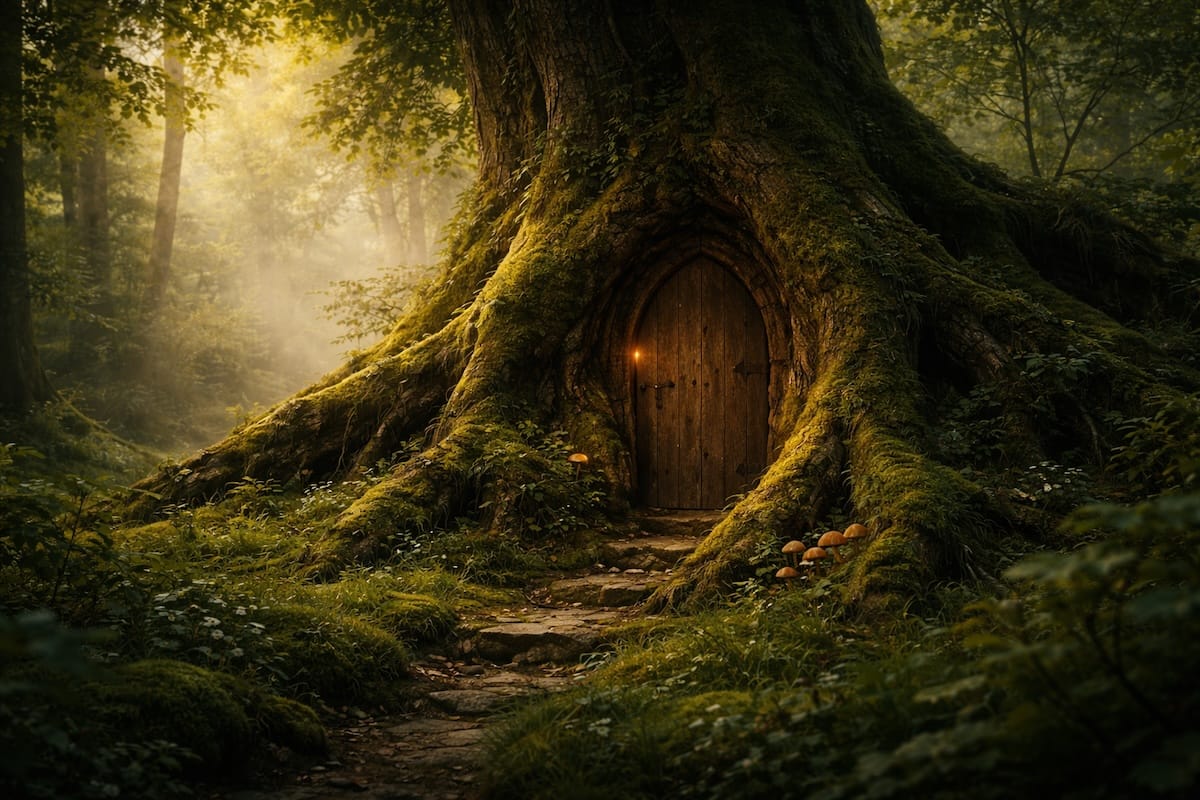
It might be a door in the roots of an old tree, a gate tucked behind ivy, a stone arch half-buried in moss, or a narrow opening discovered only by the person who was paying attention. However it appears, the meaning is usually the same: the forest is not just a setting. It is a threshold.
That is one reason forest magic endures so strongly in stories. Woodlands already feel layered, secretive, and alive in ways that invite imagination. Long before a writer adds fairies, portals, enchanted objects, or ancient guardians, the forest already carries its own atmosphere of mystery.
And that raises an interesting question.
Why do forests feel magical so easily?
The answer has a lot to do with folklore, psychology, landscape, and the way human beings respond to places that are beautiful but not fully predictable.
If you enjoyed Fairy Rings: The Real Science Behind Nature's Most Magical Circles, The Garden That Refused to Sleep, or The Purpose of Gnomes: Folklore, Protection, and Modern Interpretations, the hidden-door idea belongs naturally in that same imaginative tradition.
Why Forests Work So Well in Fantasy
Forests are naturally good at withholding information.
You cannot see very far ahead in a dense woodland. Light changes constantly beneath branches. Sound travels strangely. Paths split. Mist lingers. Familiar things begin to look unfamiliar.
That matters in storytelling.
Fantasy needs places where transformation feels possible, and forests provide exactly that. They blur the line between safety and uncertainty. They can shelter, confuse, test, or guide. They feel old. They feel inhabited, even when no one is visible.
This is why forests so often become places of discovery in stories. A hidden door in a city alley can be intriguing, but a hidden door in a forest feels inevitable. The landscape already suggests that more exists than first appears.
The Folklore Behind Forest Magic
Long before modern fantasy novels, forests were central to folklore.
In myths, folktales, and oral traditions, woods often served as places where humans crossed into the unknown. Spirits lived there. Fairies danced there. witches traveled there. Heroes became lost there and returned changed.
Part of this came from real experience. Forests were historically useful, necessary, and sometimes dangerous places. People gathered wood, food, and shelter from them, but they could also become disoriented or vulnerable there. What humans cannot fully control, they often surround with story.
That is how landscapes become enchanted.
Over time, forests were no longer just collections of trees. They became symbolic spaces where ordinary rules loosened. A hidden door is simply one of the clearest images of that older belief: that nature contains entrances to deeper worlds.
Why Hidden Doors Feel So Powerful
A hidden door is more than a fantasy prop.
It represents access.
Not everyone sees it. Not everyone can open it. And the person who finds it is usually someone who notices, wonders, waits, or believes before others do.
That idea is deeply appealing because it reflects how discovery often feels in real life. Meaning rarely announces itself loudly. It is usually found by people willing to pay attention.
This is one reason magical doors remain emotionally powerful. They are not only about escape. They are about perception. They suggest that the world may already contain more depth, beauty, and mystery than we usually notice.
In that sense, the hidden door is not only a fantasy symbol. It is also a metaphor for wonder itself.
Why Real Forests Already Feel Like Thresholds
Even without mythology, forests change our experience of space.
Step from an open road into a wooded path and several things happen at once:
- the sound softens
- the temperature often shifts
- the light becomes filtered
- your line of sight shortens
- your attention becomes more alert
That transition feels important on a sensory level. It can seem as though you have crossed from one kind of world into another.
This is probably part of why forests inspire portal imagery so often. They already create a real threshold effect. A hidden door simply gives visual form to something the landscape is doing emotionally.
The forest says: slow down, notice more, and expect the unexpected.
The Link Between Forest Magic and Childhood Wonder
Children are especially responsive to this atmosphere.
A patch of woods rarely feels ordinary to a child. It feels possible. A hollow tree might hold secrets. A trail might lead somewhere no map has marked. A gate in the undergrowth might belong to fairies, gnomes, or some kindly mysterious creature who prefers respectful visitors.
This instinct is not silly. It is a form of imaginative attention.
Children often sense what fantasy writers understand very well: mystery is more believable in places that already feel alive. Forests do not need much help becoming story-worthy.
That is part of the appeal behind your site's playful worlds too. Readers who enjoy Fairies, Fairy Sets, or The Enlightenment - A Novel are responding to that same doorway feeling: the invitation into a world where wonder is taken seriously.
Why Forests Often Symbolize Transformation
Characters rarely enter enchanted forests and leave unchanged.
That is not an accident.
In storytelling, forests often symbolize the in-between space where transformation happens. A hero gets lost, confronts something difficult, learns something hidden, and comes back altered in some meaningful way.
The hidden door fits perfectly into that pattern because doors imply passage. Once you go through one, you are no longer where you started.
Fantasy uses this beautifully, but the idea works in real life too. Time in nature can genuinely shift perspective. People leave forests calmer, clearer, or more reflective than when they entered. The change may not be magical in the literal sense, but it is often real.
That is part of why forest symbolism remains so powerful. It is imaginative, yes, but it also mirrors human experience.
Why We Keep Returning to Magical Forests
Modern life is full of hard edges, bright screens, and constant explanation.
Forests offer the opposite. They are textured, layered, and only partly knowable at a glance. They make room for uncertainty without making that uncertainty feel empty.
People are drawn to that.
We like places that leave room for imagination. We like landscapes that feel older than our schedules. We like the suggestion that mystery still exists and that not every meaningful thing has been catalogued, optimized, or fully explained.
Magical forests satisfy that longing.
They remind us that wonder is not childish in the negative sense. It is often the beginning of attention, reverence, and creativity.
If that is the kind of atmosphere you love, readers can continue exploring it through Magical Trees, Meet My Characters, or the visual fantasy world in the Gallery of the Stars.
The Hidden Door as a Symbol of Attention
Perhaps the most beautiful thing about the hidden-door image is this: it rewards noticing.
The door is not usually found by the loudest person.
It is found by the one who lingers.
The one who sees the unusual pattern in the bark.
The one who wonders why the moss looks brighter in one place.
The one who believes the world may still contain surprises.
That idea feels especially meaningful now. Attention is one of the rarest things people have to offer. The hidden door reminds us that paying attention is not passive. It is an act of relationship.
To notice a forest deeply is already to step into a slightly richer world.
Why Forest Magic Still Matters
We do not need to prove that forests literally hide enchanted doors for the image to matter.
Its power comes from what it expresses so well: that nature still contains mystery, that imagination changes the way we see, and that some places invite us into deeper awareness.
Forests feel magical because they interrupt certainty.
They soften the world enough for wonder to enter.
And the hidden door remains one of the best symbols for that experience because it captures the exact moment when curiosity becomes passage.
You are here.
You notice something.
You step closer.
And suddenly the world is larger than it was a moment ago.
That is a fantasy image, certainly.
But it is also a very human one.
Which may be why we keep returning to it, generation after generation, story after story, path after path beneath the trees.