The Language of Weather: How Animals Predict What We Miss
Discover how animals predict storms, earthquakes, and seasonal shifts long before humans do — from birds sensing pressure changes to marine life detecting distant hurricanes.
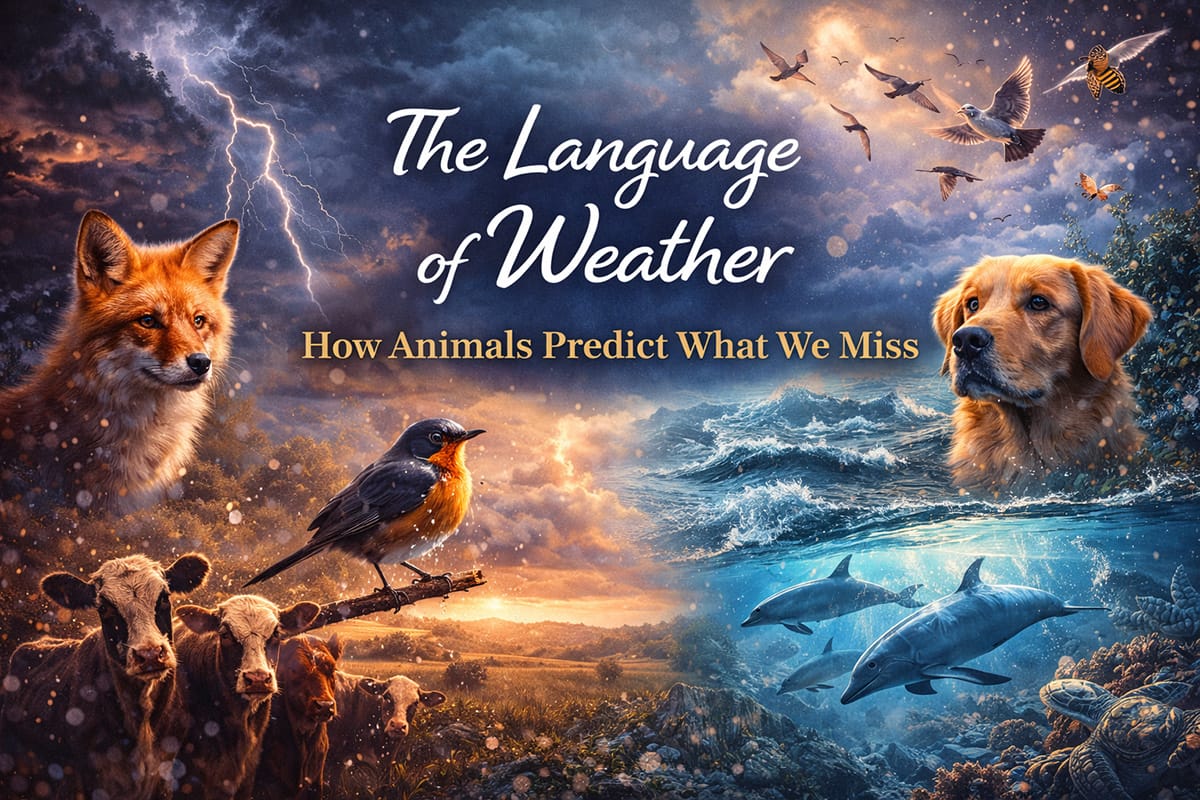
How birds, insects, mammals, and marine life sense storms, earthquakes, and seasonal shifts before humans do
There are moments when nature seems to know something we don’t.
Birds fall silent before a storm.
Cows lie down hours before rain.
Dogs pace before an earthquake.
Fish dive deeper before a hurricane hits.
And we’re left standing there, checking a weather app.
For centuries, people believed animals had “sixth senses.” Old farmers trusted swallows more than satellites. Sailors watched seabirds before watching the sky. Indigenous communities read animal behavior as carefully as wind patterns.
Now modern science is slowly catching up.
Animals aren’t psychic.
They’re tuned in.
And what they’re tuned into is a language we largely forgot how to hear.
This is the story of how animals predict storms, earthquakes, seasonal shifts, and environmental changes long before humans notice — and what that says about the way we live on this planet.
What Does It Mean to “Sense” Weather?
Let’s start here.
Animals aren’t guessing. They’re not predicting in the way meteorologists do. They aren’t forecasting based on models.
They are reacting to subtle environmental shifts we barely register:
- Tiny changes in air pressure
- Low-frequency sounds (infrasound)
- Shifts in humidity
- Variations in static electricity
- Magnetic field fluctuations
- Ground vibrations
- Chemical changes in water
To us, these changes are background noise.
To them, it’s information.
What we call instinct is often just heightened sensitivity.
The Drop Before the Storm: How Birds Read Barometric Pressure
One of the clearest examples of animal weather sensing involves birds and barometric pressure.
Before a storm, atmospheric pressure drops. You can see it on a barometer. But many birds feel it.
Studies tracking migratory birds have shown that when barometric pressure falls sharply, birds:
- Delay migration
- Seek shelter
- Change altitude
- Stop singing
- Reduce activity
In 2014, researchers observed golden-winged warblers in Tennessee. When a severe storm system formed hundreds of miles away — still invisible to the birds — the warblers abruptly left their nesting grounds and flew away before the storm arrived.
They weren’t reacting to rain.
They were responding to infrasound — ultra-low-frequency sound waves produced by massive storm systems.
Humans can’t consciously hear infrasound.
Birds can.
They detect storms forming far beyond the horizon.
Cows Lying Down Before Rain — Myth or Real?
You’ve probably heard this one: cows lie down before it rains.
It turns out, it’s not just folklore.
Cattle are sensitive to atmospheric pressure changes and humidity shifts. Before rainfall, pressure drops and air becomes heavier with moisture. Cows often lie down to conserve body heat and prepare for wet ground.
Is it a perfect predictor? No.
But livestock behavior shifts noticeably before weather changes — and farmers have relied on those cues long before weather radar existed.
Animals don’t need a forecast.
They need to survive the next few hours.
Dogs Before Earthquakes: Anxiety or Awareness?
Earthquake prediction is one of the most debated areas of animal sensing.
For centuries, reports have described:
- Dogs barking uncontrollably before tremors
- Cats fleeing buildings
- Snakes leaving burrows
- Toads abandoning breeding grounds
- Fish thrashing violently
Skeptics argue confirmation bias — we remember odd behavior when an earthquake follows and forget it when nothing happens.
But recent research suggests there may be something real happening.
Animals may detect:
- Micro-tremors before major quakes
- Changes in groundwater chemistry
- Electrostatic changes in the air
- Ground vibrations too subtle for humans
A 2018 study in Italy found that farm animals showed unusual agitation hours before measurable seismic activity.
The key difference?
Animals live closer to the ground — literally. Their sensory systems are wired to feel vibrations through soil and bone.
We live on floors, in buildings, behind glass.
We’re insulated from the earth.
Insects and the Invisible Air
Insects might be some of the most sensitive weather readers on Earth.
Ants seal nest entrances before heavy rain.
Bees return early to hives when storms approach.
Mosquito activity increases before rainfall due to rising humidity.
Many insects sense shifts in electrical charge in the atmosphere.
Before a thunderstorm, static electricity builds in the air. Some insects can detect these changes and adjust behavior accordingly.
There’s even evidence that spiders alter web-building patterns based on humidity and pressure.
To them, the air itself is textured with information.
To us, it just feels like “sticky weather.”
Marine Life and the Coming Hurricane
Now let’s go underwater.
Fish and marine mammals react dramatically to storms — often long before surface conditions shift.
Before hurricanes, fish dive deeper into the ocean to avoid turbulent surface waters. Sharks have been observed leaving coastal areas days before major storms.
How?
They detect pressure changes through specialized sensory organs. Fish have swim bladders that are highly responsive to pressure shifts. When atmospheric pressure drops sharply, it affects water pressure too.
Some marine animals also detect infrasound waves traveling across the ocean — the low rumble of massive storm systems long before they hit land.
In 2004, after the Indian Ocean tsunami, coastal areas reported an eerie absence of certain wildlife before the wave struck.
Animals didn’t “predict” the tsunami.
They reacted to seismic shifts we couldn’t perceive.
Magnetic Fields and Migration Timing
Weather prediction isn’t just about storms.
Animals also anticipate seasonal shifts — often before visible cues appear.
Birds, sea turtles, salmon, and even some mammals use Earth’s magnetic field for navigation.
But here’s where it gets interesting:
Magnetic fields can fluctuate slightly due to solar activity and atmospheric changes. Some species appear sensitive to these fluctuations, adjusting migratory timing accordingly.
Salmon begin returning to spawning rivers based on a combination of temperature shifts, water chemistry, and magnetic orientation.
Monarch butterflies initiate migration based not only on daylight hours but subtle seasonal environmental cues.
They don’t wait for winter to arrive.
They leave before it does.
Why Humans Struggle to Notice What Animals Feel
So why don’t we sense these changes?
We can, to a degree. Some people experience:
- Joint pain before rain
- Headaches with pressure changes
- Migraine shifts before storms
Our bodies respond to barometric pressure.
But we’ve dulled our environmental awareness.
We live in climate-controlled spaces.
We move on pavement instead of soil.
We rely on forecasts instead of the sky.
Animals are embedded in their environments.
We are buffered from ours.
Over time, that buffering becomes disconnection.
The Science of Infrasound: Hearing the Unheard
One of the most fascinating mechanisms animals use is infrasound detection.
Infrasound refers to sound waves below 20 Hz — too low for human ears.
But many animals can sense it:
- Elephants use infrasound to communicate across miles.
- Birds detect storm-generated infrasound.
- Whales rely on low-frequency sound for long-distance signaling.
Large storm systems, volcanic eruptions, and ocean waves all generate infrasound.
To animals, these events announce themselves early.
To us, they arrive as surprise.
Climate Change and Disrupted Signals
There’s a darker side to all this.
Animals evolved to interpret stable environmental patterns.
But climate change is scrambling those signals.
Migration timing mismatches food availability.
Flowering seasons shift.
Ocean temperatures change faster than animals can adapt.
If the cues become unreliable, survival strategies falter.
When animals “misread” the weather, it’s often because the language itself has changed.
And that affects entire ecosystems.
What This Teaches Us
The more we study animal weather sensing, the more we realize:
The world is constantly communicating.
Through vibration.
Through pressure.
Through magnetism.
Through sound we can’t hear.
Animals aren’t mystical.
They’re attentive.
They don’t dominate their environment.
They respond to it.
And maybe that’s the difference.
Can We Relearn the Language?
We may never match a bird’s infrasound sensitivity or a fish’s pressure awareness.
But we can practice noticing:
- When birds suddenly quiet
- When insects vanish before storms
- When the air feels charged
- When wildlife behavior shifts
Not as superstition.
As observation.
The more attention we give to the natural world, the less mysterious it becomes — and the more respectful we grow.
The Language We Forgot
Animals don’t forecast the weather.
They participate in it.
They are part of the same system that creates wind, pressure, vibration, and seasonal change.
We stepped outside that system — into houses, vehicles, artificial light — and we gained comfort, but lost immediacy.
Maybe the lesson isn’t that animals can predict what we miss.
Maybe it’s that they never stopped listening.
And maybe, if we slow down, step outside, and pay attention, we’ll start hearing pieces of that language again.