The Long Way Home: Animals That Travel Ridiculous Distances
Explore the unbelievable journeys of migrating animals — from monarch butterflies to Arctic terns — and discover how wildlife travels vast distances to survive.
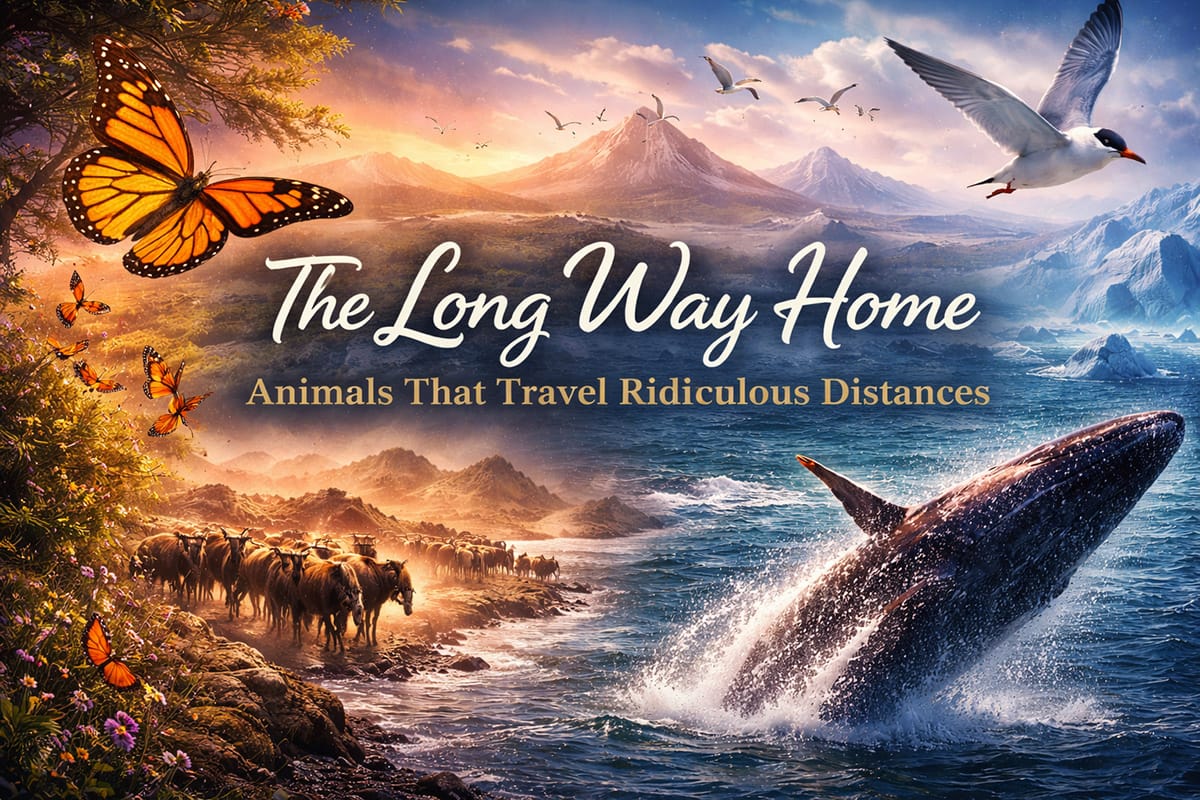
Every year, without fanfare, without maps, without packed bags or farewell parties, millions of animals set off on journeys that would break most humans.
They don’t post updates.
They don’t know where they’ll sleep.
They don’t always know if they’ll survive.
And yet — they go.
Some cross continents.
Some cross entire oceans.
Some travel farther in a lifetime than many people will in theirs.
This is the story of animal migration — not as a checklist of facts, but as one of the most extraordinary, stubborn, and quietly brave things life on Earth does again and again.
What Migration Really Is (And Why It Exists at All)
At its simplest, migration is movement — animals traveling from one place to another, usually seasonally, usually for survival.
But that definition barely scratches the surface.
Migration is:
- A response to disappearing food
- A search for safer breeding grounds
- An escape from cold, heat, drought, or darkness
- A memory written into muscle, instinct, and genetics
No one teaches these animals the route.
A monarch butterfly doesn’t pull out directions.
An Arctic tern doesn’t practice the flight in advance.
They are born knowing something — a pull, a restlessness, a sense of “not here anymore.”
And that pull can stretch across half the planet.
The Monarch Butterfly: Fragile Wings, Unbelievable Distance
If there were a prize for “least likely long-distance traveler,” the monarch butterfly would win.
They look delicate. Temporary. Almost too light for the wind.
And yet, monarchs migrate up to 3,000 miles.
Every fall, monarchs from Canada and the northern United States begin drifting south toward a few specific mountain forests in central Mexico. They funnel down into tiny areas of oyamel fir trees — places their great-great-grandparents visited, though none of them ever have.
Here’s the astonishing part:
The butterflies that arrive in Mexico are not the same individuals that left the year before.
It takes multiple generations to complete the full migration cycle. One generation starts the journey. Another continues it. A final “super generation” lives longer than usual to make the full trip south.
They are following a path they have never flown before.
When they cluster together on those trees — thousands of wings layered like living leaves — it’s not just beautiful. It’s almost impossible.
Arctic Terns: The Longest Commute on Earth
If migration had a world record holder, the Arctic tern would own it outright.
This seabird travels from the Arctic to Antarctica and back again every year — roughly 25,000 miles annually. Over its lifetime, one tern may fly the equivalent of three trips to the moon and back.
Why?
Because Arctic terns chase summer.
They experience more daylight than any other animal on Earth, living almost entirely in long, bright seasons. They fish in cold waters, nest in polar regions, then glide across oceans, continents, and hemispheres to reach another endless summer on the opposite end of the planet.
They don’t rush.
They don’t fly straight.
They follow winds, currents, and food-rich paths invisible to us.
It’s not speed that gets them there.
It’s endurance.
Wildebeest: The Ground-Level Epic
Migration isn’t always about wings.
On the African plains, over a million wildebeest, along with zebras and gazelles, move in a massive, living tide across the Serengeti and Maasai Mara.
This migration is driven by rain.
Grass grows, water shifts, and the herds follow — slowly, relentlessly, often dangerously. Rivers filled with crocodiles. Predators waiting at the edges. Calves born mid-journey.
This isn’t a single line of travel. It’s a looping cycle — a moving ecosystem that feeds predators, nourishes soil, and shapes the entire landscape.
When people call this “the Great Migration,” it’s not exaggeration.
It’s a reminder that movement itself can be an ecological force.
Whales: Singing Across Oceans
Some of the largest migrations belong to the largest animals that have ever lived.
Gray whales travel up to 12,000 miles round-trip between feeding grounds in the Arctic and breeding lagoons in Mexico. Humpback whales cross entire ocean basins, navigating with a precision we still don’t fully understand.
They migrate:
- To give birth in warmer, safer waters
- To feed in cold, nutrient-rich seas
- To follow rhythms older than human memory
Whales communicate during these journeys — low-frequency songs that can travel for miles underwater. Their migration is not silent. It’s musical, communal, ancient.
When a whale reaches its destination, it’s not just arrival.
It’s reunion.
Birds That Travel Through the Night
Many migratory birds travel under cover of darkness.
Why?
- Cooler air
- Fewer predators
- Clearer navigation using stars and Earth’s magnetic field
Songbirds that look tiny and unremarkable in your backyard may fly thousands of miles between continents, stopping briefly in forests, wetlands, or even city parks to refuel.
A small patch of green can be the difference between survival and exhaustion.
This is why habitat loss hits migratory species so hard. Remove one resting point, and an entire journey can collapse.
Migration depends on chains, not single destinations.
How Do They Know Where to Go?
This is the question that never quite gets answered.
Scientists know animals use:
- Earth’s magnetic field
- Sun position
- Star patterns
- Smell
- Landmarks
- Ocean currents
But knowing the tools doesn’t explain the experience.
At some point, knowledge turns into instinct.
Instinct turns into motion.
Motion turns into survival.
Migration is memory without language.
The Cost of These Journeys
Not every animal makes it.
Storms shift.
Food disappears.
Temperatures change.
Human obstacles appear — roads, buildings, lights, noise, ships.
Climate change is altering migration timing and routes faster than some species can adapt. When arrival no longer matches food availability, entire populations can falter.
Migration works only when the world stays somewhat predictable.
Right now, predictability is slipping.
Why These Journeys Matter to Us
It’s easy to admire migration as something distant — beautiful, tragic, impressive.
But it’s also a mirror.
Migration shows us:
- The cost of survival
- The power of persistence
- The danger of breaking natural systems
- The quiet intelligence of life that doesn’t need us to explain it
These animals don’t migrate for wonder.
They migrate because staying still would kill them.
And yet, in doing so, they create some of the most breathtaking stories on Earth.
The Long Way Home
Migration isn’t about leaving.
It’s about returning — to food, to safety, to light, to life.
Whether it’s a butterfly drifting south on borrowed air, a bird crossing hemispheres under the stars, or a whale singing its way across the ocean, these journeys remind us of something simple and profound:
Movement is hope.
Memory can be inherited.
And sometimes, the only way forward is a very long way around.