The Moon and the Migration: How Light Guides Wildlife
Exploring moon and animal behavior, lunar wildlife patterns, and the quiet rhythm shaping migration
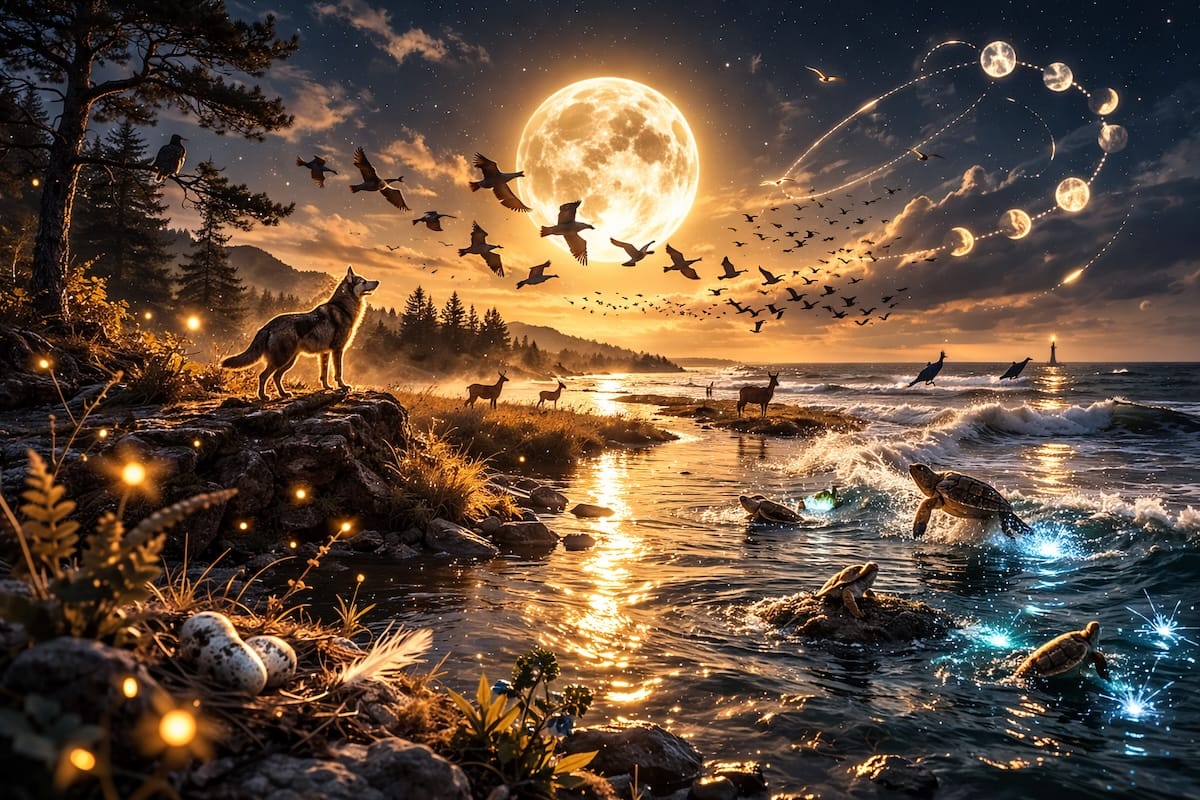
On a cold February night, the world feels still.
The ground holds winter. The trees are quiet. The air carries that sharp, waiting feeling — the kind that comes just before change.
And above it all, the Moon rises.
It looks peaceful. Decorative. Almost unnecessary.
But for wildlife, the Moon is not decoration.
It’s a guide.
It’s a signal.
It’s part of a timing system older than forests, older than oceans, older than memory itself.
As late winter begins to loosen its hold and migration slowly gathers momentum, animals aren’t just watching the weather or the daylight.
They’re watching the Moon.
The Moon: Nature’s Night Clock
We usually think of seasons as solar stories.
Spring arrives when the days grow longer. Winter deepens when sunlight fades. The Sun drives the big picture — warmth, growth, dormancy.
But nighttime tells its own story.
Every month, the Moon shifts from darkness to brilliance and back again. These changes in light aren’t random — they follow a steady cycle that animals have evolved alongside for millions of years.
To humans, moonlight is romantic.
To wildlife, it’s information.
A full moon turns darkness into visibility. A new moon deepens shadows. Between them lies a gradient of brightness that subtly changes how animals move, hunt, migrate, and reproduce.
In this way, the Moon becomes a kind of clock — one that ticks in light instead of sound.
Migration Doesn’t Begin All at Once
When we imagine migration, we picture dramatic moments.
Flocks filling the sky. Herds crossing rivers. Whales moving across open ocean.
But migration doesn’t start in a single instant.
It builds quietly.
Late winter is full of subtle preparation:
- Hormones shift
- Fat reserves increase
- Restlessness appears
- Movement becomes more deliberate
This is when animals begin sensing that change is coming.
And while temperature and daylight play major roles, lunar wildlife patterns add another layer.
The Moon doesn’t trigger migration.
It helps time it.
Night Migrators and Lunar Light
Many migrating birds travel at night.
Cooler air makes flight more efficient. Darkness offers protection from daytime predators.
But not all nights are equal.
Under a full moon, landscapes become faintly visible from above. Rivers shimmer. Coastlines glow softly. Even snow-covered fields reflect extra light.
This improved visibility can influence how and when birds move.
Some species appear more active under certain lunar phases. Others adjust altitude to balance visibility with safety.
Too much brightness can increase predator exposure.
Too little can complicate navigation.
The Moon creates a middle ground — a shifting balance that wildlife learns to read.
The Ocean’s Lunar Rhythm
If the Moon shapes land movement gently, it shapes ocean life dramatically.
Through gravity, the Moon drives tides. And tides shape marine ecosystems.
Fish spawning, coral reproduction, and plankton movement often follow lunar cycles. In some cases, mass spawning events occur only during specific phases — often near full or new moons.
Sea turtles provide one of the clearest examples of moon and animal behavior.
When hatchlings emerge from nests, they instinctively move toward the brightest horizon — historically, the ocean reflecting moonlight.
Artificial light can confuse this navigation, drawing them inland instead.
The Moon isn’t just illuminating the sea.
It’s directing life toward it.
Land Animals and the Brightness Problem
On land, moonlight changes risk.
For predators, a bright night offers better visibility.
For prey, it increases exposure.
Rodents and small mammals often reduce activity during full moons, waiting for darker nights to forage more safely. Predators, in turn, may adjust their hunting strategies depending on lunar brightness.
Late winter is especially delicate.
Food is scarce. Energy reserves are low. Movement must be efficient.
Under bright moonlight, animals weigh hunger against danger.
The Moon doesn’t force decisions.
It changes the odds.
The Hunger Season and Lunar Timing
February and early March are often the hardest stretch of the year for wildlife.
Winter has drained reserves. Spring hasn’t yet delivered abundance.
Movement becomes necessary — but risky.
In this fragile period, lunar cycles influence small behavioral choices:
- When to forage
- When to travel
- When to hide
Over time, these choices affect larger migration patterns.
A darker night may allow safe movement toward feeding grounds.
A brighter night may delay it.
The Moon becomes part of survival math.
Amphibians and the Moonlit Journey
As winter begins to loosen, amphibians prepare for breeding migrations.
Frogs and salamanders often move toward breeding ponds during specific combinations of warmth, rainfall, and seasonal timing.
Some evidence suggests lunar phases also influence these movements.
Brighter nights may aid navigation across forest floors.
Full moons often coincide with increased calling activity.
Imagine thousands of frogs moving through thawing woods under silver light — guided not by roads or landmarks, but by brightness itself.
It’s not magic.
But it feels close.
Insects: Navigating by Light
Many insects rely on celestial cues for orientation.
The Moon provides a stable reference point — far enough away to remain fixed in the sky.
Artificial lights confuse this system, causing the familiar spirals around lamps.
In natural conditions, lunar brightness can influence activity levels and movement patterns.
And because insects sit at the base of many food webs, these shifts ripple outward.
Birds preparing for migration depend on insect abundance.
So do bats and amphibians.
The Moon’s influence travels indirectly through ecosystems.
Circalunar Rhythms: Internal Timing
Some species appear to possess internal lunar clocks.
Just as circadian rhythms follow daily light-dark cycles, circalunar rhythms track lunar phases.
Marine organisms, in particular, show behaviors that anticipate rather than merely respond to lunar change.
They don’t wait for brightness.
They prepare for it.
This suggests the Moon isn’t just an external signal — it’s embedded in biological timing itself.
Light Pollution and Lost Signals
Modern artificial lighting complicates this ancient system.
Cities glow constantly, erasing distinctions between new moon darkness and full moon brightness.
Migratory birds may become disoriented.
Sea turtle hatchlings may head inland.
Insects may lose their navigational cues.
When we flood the night with light, we blur the Moon’s guidance.
For species that evolved alongside predictable lunar cycles, this interference matters.
Late Winter: A Season of Subtle Movement
By late February, change is underway.
Daylight lengthens.
Snow softens.
Rivers shift beneath ice.
Birdsong begins in tentative bursts.
Migration is not yet obvious — but it’s coming.
The Moon during this period reflects off lingering snow, amplifying brightness.
It reveals thawing edges.
It lights the first cautious movements.
The sky becomes part of the ecosystem again.
The Moon as Companion, Not Commander
It’s important to remember:
The Moon does not command migration.
It accompanies it.
The Sun drives the season.
The Moon fine-tunes the night.
Together, they shape when and how wildlife moves.
Watching the Pattern
The next time a full moon rises over a late-winter landscape, notice how different the world feels.
The snow glows.
The trees cast shadows.
The night becomes navigable.
Somewhere above, birds may be adjusting course.
Somewhere below, mammals may be weighing movement.
Somewhere near water, amphibians may be preparing to travel.
Migration rarely announces itself.
It begins quietly.
And the Moon is there.
Steady.
Predictable.
Waiting.
Final Thoughts: The Sky Still Matters
We often think of ecosystems as rooted in land and water.
But they extend upward.
Wind patterns, temperature gradients, and celestial light all play roles.
The Moon may seem distant.
Yet its influence reaches forests, wetlands, coastlines, and open skies.
In late winter, as the world prepares to shift toward spring, that influence becomes visible again.
The Moon rises.
Migration gathers.
And guided by light older than memory, life begins to move.