The Secret Lives of Fireflies
A whimsical nature story about light, language, and the hidden poetry of summer nights
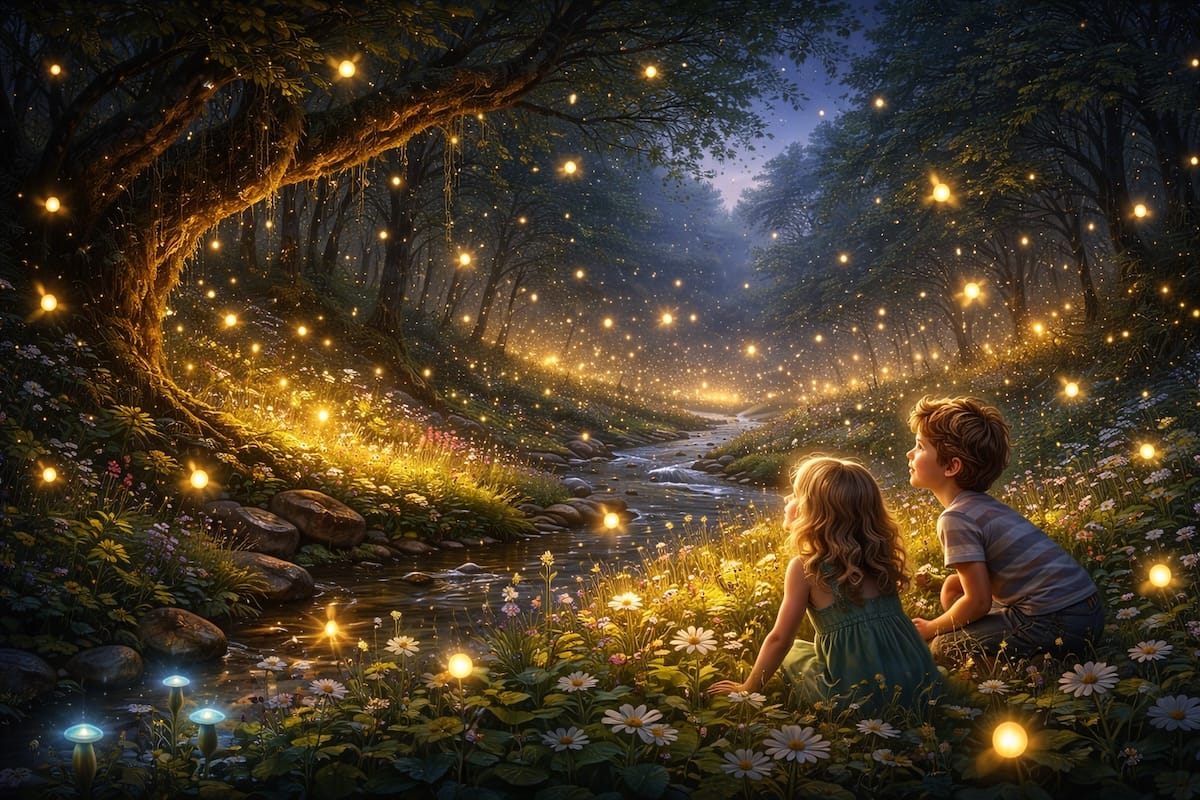
There’s something about fireflies that makes even practical people pause.
You can be the most logical, spreadsheet-loving adult in the world—but the moment those tiny lights begin blinking across a dark field, something in you softens. You stop talking. You look up. You feel like you’re standing inside a secret.
Scientists will tell you fireflies blink to attract mates. That’s true. It’s biology. It’s chemistry. It’s survival.
But here’s the thing.
When you’re standing in a forest at dusk and hundreds of tiny lanterns flicker in deliberate patterns—slow, fast, pause, glow—it doesn’t feel random. It feels like a conversation.
So let’s imagine something gentle and a little magical.
What if fireflies aren’t blinking at random at all?
What if they’re sending coded messages across the forest?
Welcome to the secret lives of fireflies.
Are Fireflies Really Random?
In reality, fireflies use bioluminescence—a chemical reaction inside their bodies that produces light without heat. Different species blink in different patterns. Some pulse steadily. Others flash in bursts. In certain parts of the world, entire groups synchronize their lights like living constellations.
That’s science.
But even science admits something fascinating: their flashing is highly specific. It’s patterned. It’s intentional.
Now imagine that instead of thinking of these patterns as simple mating signals, we see them as something more layered. A forest-wide telegraph system. A language built from light.
One long glow.
Two short flickers.
A pause.
Another shimmer.
What if that sequence means:
The river is rising.
Or:
The night-blooming flowers have opened.
Or even:
The wind is shifting. Prepare.
Suddenly, a summer meadow becomes a living message board.
A Magical Forest Fantasy of Light and Language
Let’s step into a magical forest fantasy for a moment—not loud fantasy with dragons and battles. Just soft twilight magic.
The forest breathes differently at night. Trees stretch into silhouettes. Leaves whisper. The air cools. That’s when the fireflies begin.
One light appears near the ground.
Then another higher up in the branches.
Then five more across the clearing.
At first, it feels scattered. But if you watch long enough, you notice rhythm.
The old oak tree blinks in slow pulses—three in a row, always steady. The meadow grasses flicker rapidly, as if gossiping. Near the riverbank, the flashes are patient and spaced apart, like someone choosing their words carefully.
What if each cluster of fireflies belongs to a part of the forest?
The river has its own dialect.
The meadow has its own tone.
The deep woods speak in longer pauses.
In this whimsical nature story, fireflies are not insects drifting randomly through the dark. They are the translators of the forest’s thoughts.
The Forest Telegraph System
Picture it like this.
A storm is forming miles away. Clouds gather. Pressure drops. The trees feel it before we do. The soil tightens. The air thickens.
And then the fireflies begin to flash in a different rhythm.
Fast-fast-pause.
Fast-fast-pause.
Long glow.
The message spreads from tree to tree, field to field, like a ripple. Within minutes, the entire forest is aware.
Birds settle early.
Small mammals retreat to burrows.
Flowers close their petals.
All because the fireflies carried the warning.
In real life, animals often sense weather changes before humans. They respond to subtle environmental shifts we barely notice. So this idea isn’t entirely fantasy—it’s just… extended a little. Softened. Illuminated.
What if fireflies are the visible pulse of that awareness?
Firefly Symbolism: Why We’ve Always Felt It
Across cultures, firefly symbolism has always leaned toward hope, guidance, and fleeting beauty.
In some traditions, fireflies represent souls. In others, they symbolize inspiration—tiny sparks of creativity in the dark. Japanese folklore often treats them as poetic beings tied to longing and love. In parts of North America, they’re seen as reminders of summer’s brief magic.
Notice something?
No culture treats fireflies as ordinary.
They are nearly always symbols of something hidden but meaningful. Light in darkness. Messages in silence. Presence in absence.
Maybe we’ve always sensed they’re communicating—just not in words we can translate.
The Archivists of Summer
Here’s another possibility.
What if fireflies don’t just send messages—they record them?
Imagine every blink stores something.
A promise whispered under a tree.
A secret shared beside a lake.
A laugh that echoes through tall grass.
Each summer, the forest gathers stories. Not in books. Not in carvings. In light.
When fireflies flash, they replay fragments of memory. Tiny archives of human and animal moments stitched into the evening air.
That couple who met in the meadow twenty years ago?
Their laughter is still there, flickering faintly.
The child who ran barefoot through the field?
Her joy pulses softly near the ground.
It’s gentle magical realism—the idea that nature remembers more than we think.
And honestly, doesn’t it feel true in a strange way? Some places hold memory. You step into them and feel something you can’t explain.
Maybe the fireflies are the ones keeping track.
Why Children Understand First
Have you noticed something about fireflies?
Children chase them.
Adults observe them.
There’s a difference.
A child doesn’t see blinking insects. They see signals. They assume meaning. They invent translation without hesitation.
“That one blinked twice!”
“It’s answering the other one!”
“They’re talking!”
Children don’t need proof to recognize patterns. They expect the world to be alive.
In our whimsical nature story, children are the only ones who can begin to decode the firefly language. Not because they’re smarter—but because they’re open.
They don’t dismiss mystery immediately.
And maybe that’s the quiet point of all this: sometimes understanding requires imagination, not analysis.
Fireflies as Mapmakers
Let’s shift the idea slightly.
What if fireflies aren’t just communicating in the present—they’re mapping the forest?
When you stand on a hill at night and watch them flicker, it almost looks like stars have descended into the grass. Constellations rearranged at ground level.
What if their patterns trace invisible pathways?
Safe trails through dense woods.
Shallow crossings along rivers.
Clearings where the soil is soft and welcoming.
Travelers who know how to read the light could move through the forest without fear.
In ancient myths, people followed stars. In this softer fantasy, you follow fireflies.
The coded glow becomes a guidebook written in pulses.
The Science That Makes It Possible
Now let’s come back to reality for a moment—because the real biology is just as fascinating.
Fireflies produce light through a chemical reaction involving luciferin, luciferase, oxygen, and ATP. The result is nearly 100% efficient light—almost no heat. It’s one of the most efficient natural light sources on Earth.
Different species have different flashing rhythms. Some flash once every few seconds. Others flicker rapidly. In Southeast Asia and parts of North America, certain species synchronize in breathtaking displays, lighting up entire riverbanks in waves.
Think about that.
Thousands of individual insects coordinating their flashes.
If that’s not the closest thing to a living language we’ve seen in the wild, what is?
Science explains the mechanics. But it doesn’t erase the wonder.
In fact, it deepens it.
What We Miss When We Stop Watching
Here’s something quietly important.
Firefly populations are declining in many parts of the world due to habitat loss, light pollution, and pesticide use. Artificial lights disrupt their communication. Remove darkness, and you remove their language.
That feels symbolic, doesn’t it?
We flood the night with brightness—and silence something delicate.
Maybe part of writing a magical forest fantasy like this is also remembering the real creatures behind the metaphor. If fireflies are messengers, then preserving dark spaces becomes an act of listening.
Turn off the porch light once in a while. Let the night speak.
The Gentle Truth Behind the Fantasy
Do fireflies actually send coded warnings about storms?
No.
Do they archive human memories?
Not literally.
But here’s what this whimsical nature story is really about.
It’s about paying attention.
Fireflies remind us that the world is layered. That communication doesn’t always look like words. That patterns exist even when we don’t immediately understand them.
In reality, animals sense pressure changes before storms. Plants communicate chemically through roots and airborne signals. Ecosystems operate as networks, constantly exchanging information.
The forest is already talking.
We just rarely slow down enough to notice.
Fireflies make the conversation visible.
A Final Summer Evening
Picture one last scene.
You’re standing at the edge of a quiet field. The sky is deep blue, almost indigo. Crickets begin their steady rhythm. The air smells like warm grass.
Then, one light.
Another.
A small pulse near your feet.
Soon the entire field is blinking.
If you let yourself imagine—just for a second—you can almost see sentences forming. A slow ripple of brightness moving from tree line to meadow, from meadow to riverbank.
It feels coordinated. Intentional. Alive.
Maybe that’s enough.
Maybe the secret lives of fireflies don’t require literal translation. Maybe their magic lies in the possibility that something so small can transform darkness into language.
And maybe the real coded message isn’t meant for the forest at all.
Maybe it’s for us.
Slow down.
Look closely.
The world is brighter than you think. ✨