Why Forest Paths Feel Like Portals in Fantasy Stories
Why do forest paths feel so magical in fantasy? Explore the folklore, symbolism, and atmosphere that make woodland paths feel like portals.
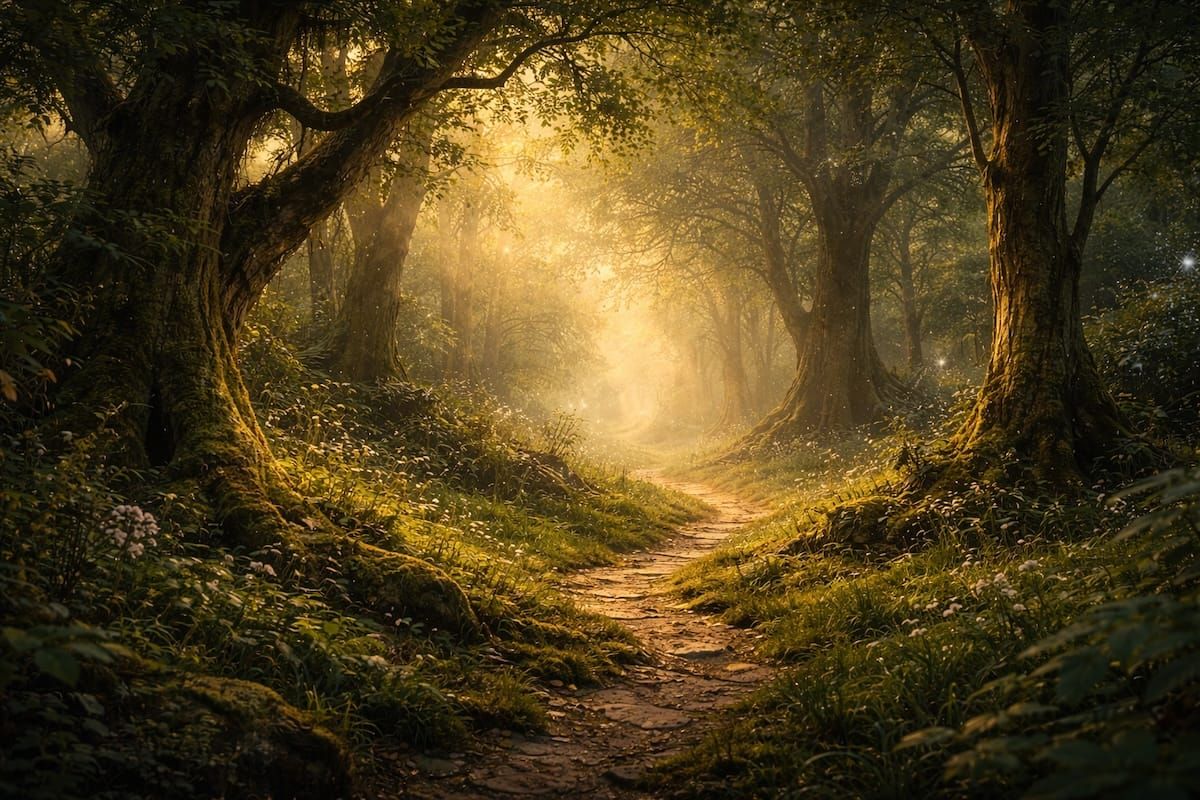
There is something about a forest path that immediately changes the way a story feels.
The moment a character steps off the road and into the trees, the world seems to shift. The air feels different. Light changes. Sound softens. Distance becomes harder to judge. Even before anything magical happens, the setting itself begins to suggest that it could.
That is why forest paths appear so often in fantasy stories.
They do not just connect one place to another. They feel like thresholds. A path through the woods can lead deeper into mystery, into danger, into wonder, or into some hidden truth that could not be found in an ordinary open field. In fantasy, a forest path is rarely just a route. It is an invitation.
But this feeling did not begin with modern novels.
Long before portal fantasy became a recognized genre, forests already held a special place in myth, folklore, and imagination. Woods were places of testing, transformation, hiding, and revelation. Paths through them became natural symbols for crossing from the known world into the unknown.
If you have enjoyed posts like Fairy Rings: The Real Science Behind Nature’s Most Magical Circles or The Garden That Refused to Sleep, the forest-path idea belongs naturally in that same enchanted tradition.
Why Forest Paths Feel Different From Ordinary Roads
A road usually promises clarity.
It is open, visible, and built for direct movement. You can often see where it leads, or at least understand its logic. Forest paths are different. They narrow. They bend. They disappear briefly behind trees and roots. They do not always show you the ending from the beginning.
That matters in storytelling.
Fantasy depends on uncertainty in a particular way. It needs room for surprise. A forest path creates that room almost automatically. It limits visibility, softens control, and makes every turn feel like a possible reveal.
Even in real life, a woodland path changes the pace of attention. People tend to walk differently there. More slowly. More carefully. More curiously. That shift in behavior helps explain why forest paths feel so naturally suited to fantasy. They ask for a different state of mind.
The Forest as a Threshold Space
One reason forest paths feel portal-like is that forests themselves already function as threshold spaces.
A threshold is a place between one condition and another. It is neither fully here nor fully there. Forests often feel exactly like that.
Step from a village lane, a city park edge, or a wide field into a denser path under trees, and several things happen at once:
- light becomes filtered
- sound becomes softer or stranger
- temperature may change
- the landscape becomes less fully visible
- your attention becomes more alert
This is a real sensory transition, not just a literary trick.
Because the environment changes so quickly, the mind reads it as significant. We feel that we have crossed into a different kind of space. Fantasy stories simply build on that natural feeling and give it symbolic meaning.
Why Folklore Put So Many Important Things in the Woods
In older stories, forests were rarely empty backgrounds.
They were places where people met spirits, witches, fairies, wolves, outlaws, hidden houses, magical helpers, and unexpected versions of themselves. A person might enter the woods as one kind of character and return as another.
There are practical reasons for this.
Historically, forests were both useful and uncertain. They provided fuel, food, shelter, and materials, but they also carried risk. It was easier to get lost there. It was easier to imagine unseen life there. The less control humans had over a place, the easier it became to fill that place with story.
That is part of how folklore works. It gathers around landscapes that already feel powerful.
A forest path, then, becomes more than a route through trees. It becomes the line between ordinary life and whatever waits beyond ordinary understanding.
Why Paths Matter More Than Forests Alone
A forest can feel magical on its own, but a path adds direction.
That direction is important because stories need movement.
A hidden grove may be enchanting, but a path suggests choice, progress, and consequence. Should the character keep going? Turn back? Follow the stranger? Ignore the warning? Take the narrower trail?
The path introduces narrative tension.
It also creates intimacy. When a character follows a path, they are not just standing in wonder. They are participating in the unknown one step at a time.
That is one reason readers respond so strongly to path imagery. It mirrors human experience. Most important changes in life do not happen all at once. They begin with entering a different kind of road before we fully know where it leads.
Why Forest Paths Work So Well in Portal Fantasy
Portal fantasy is built around crossing from one world into another.
Sometimes that doorway is obvious: a wardrobe, a mirror, a magical key, a hidden gate. But sometimes the portal is less literal. Sometimes it is a path that becomes stranger the deeper you go.
Forest paths are perfect for this because they already feel transitional.
They can narrow into mystery.
They can vanish into mist.
They can lead to a forgotten house, a secret garden, a ring of stones, or a kingdom hidden just beyond ordinary sight.
And even when no official "portal" appears, a forest path can create the emotional effect of one. The character enters as a person of the ordinary world and begins to feel that the rules around them are loosening.
That is often enough to make the path itself function like a doorway.
Why Children’s Stories Love Forest Paths
Children's literature returns to forest paths again and again because children understand instinctively what those paths offer.
They offer scale, secrecy, and possibility.
A child on a path feels both small and important. The world becomes bigger, but attention becomes sharper. Every branch, turning, and clearing might matter.
That is a powerful emotional combination.
Children are often especially open to the idea that a path could lead somewhere extraordinary. They do not need much convincing that hidden worlds exist beside visible ones. A path into the woods feels like evidence.
This is one reason the idea fits so naturally with the imaginative world of your site, including sections like Fairies, Fairy Sets, and Meet My Characters. The appeal lies not only in magic itself, but in the sense that magic may be waiting just off the familiar route.
Why Real Forest Paths Feel Magical Too
We do not need fantasy creatures on the trail for a forest path to feel enchanted.
Real woodland paths already do a great deal of emotional work.
They slow us down. They frame the landscape. They reveal and conceal in alternating rhythms. They make sound behave differently. They draw the eye forward while limiting certainty about what lies ahead.
This combination creates a feeling of layered space. The world does not seem flat on a forest path. It seems folded.
That folded feeling may be one of the deepest reasons forest paths feel magical. They imply more than they show.
And in both storytelling and real life, mystery often begins exactly there.
Why Forest Paths Often Symbolize Transformation
Characters who enter forest paths rarely leave unchanged.
That is not accidental.
In fantasy and folklore, forest journeys often symbolize transition. A character may leave childhood, innocence, certainty, or comfort behind. Along the path, they meet challenges, helpers, temptations, truths, and choices. By the time they return, something has shifted inside them.
The path matters because transformation feels more believable when it happens in motion.
A path is a process, not a single event. It allows change to unfold gradually.
That makes it one of the most useful symbols in fantasy storytelling. It is not just where the character goes. It is what the character becomes while going there.
If you enjoy that blend of symbolic landscape and emotional change, you may also like The Power of Myth: How Ancient Legends Shape Modern Fantasy and Portal Fantasy: Why We Love Stepping Into Other Worlds.
Why We Keep Returning to This Image
Even now, in a world full of maps, screens, and clear directions, forest paths still capture imagination.
Part of that is visual. They are beautiful.
Part of it is emotional. They suggest that not everything meaningful is immediately visible.
And part of it is deeply human. We are drawn to places that feel like invitations rather than instructions.
A forest path does not usually command. It beckons.
It says there may be more ahead, but you must choose to continue.
That feeling is central to fantasy, but it also matters outside fiction. People often long for places that create wonder without explaining everything at once. A path through trees does exactly that. It offers shape without full certainty.
More Than a Path
That is why forest paths feel like portals in fantasy stories.
They are not only practical routes through woodland. They are emotional and symbolic passageways. They mark the moment when the familiar world begins to loosen and something larger starts to emerge.
Sometimes that larger thing is magic.
Sometimes it is danger.
Sometimes it is transformation.
Often, it is all three.
The next time you see a path disappearing into trees, it may be worth noticing how quickly your imagination responds. Even before you take a step, some part of you already understands the old story logic: this is where the ordinary world might end and something more interesting might begin.
And perhaps that instinct has lasted so long because it still feels true.
A forest path is never only a path.