Bare Trees in Fantasy: Building a Setting From Branches and Silhouettes
Bare branches reveal windows, frame distant landmarks, and change a character’s choices. See how a leafless tree can give a fantasy setting its shape.
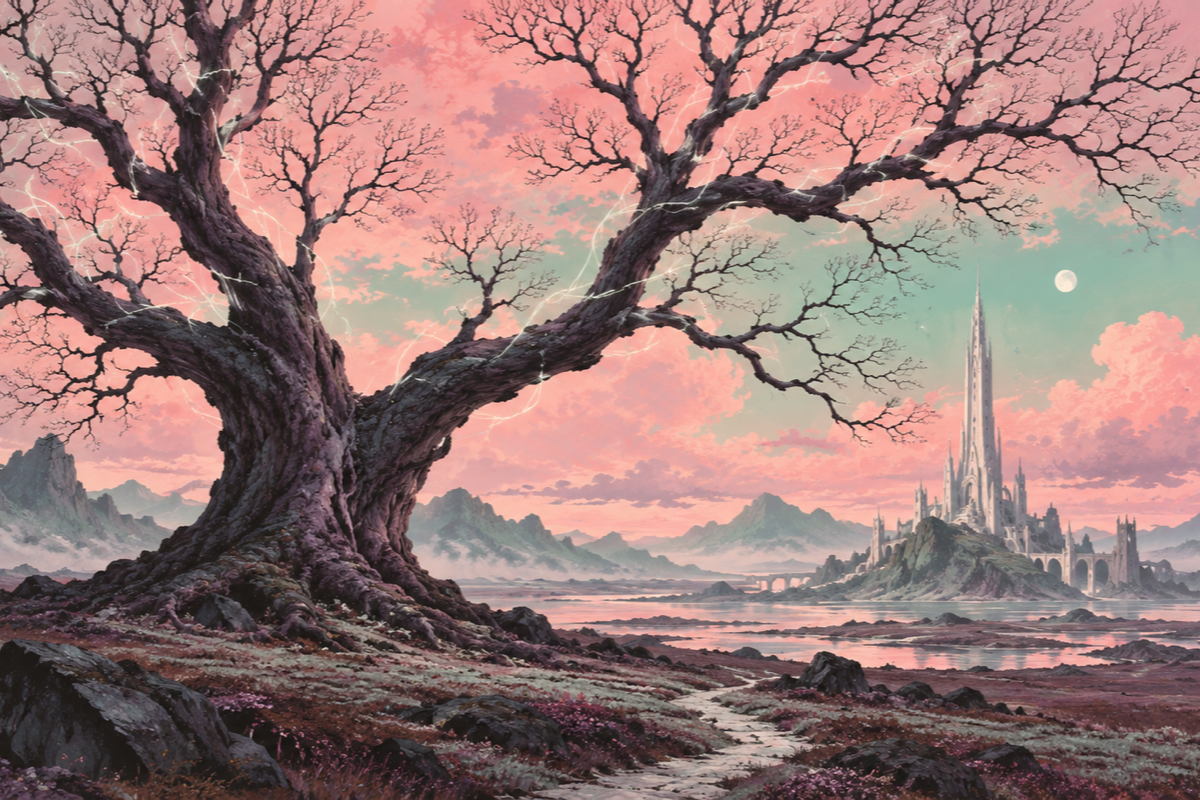
Take the leaves off a tree in a fantasy illustration and see what happens to the picture. A house appears behind it. Two branches that seemed insignificant become the strongest lines in the scene. The sky takes up more space, and the distance between the tree and the next building becomes easier to judge.
That change gives writers and illustrators useful material. A bare tree can reveal the layout of a place, create a recognizable landmark, or alter the balance of privacy and exposure. It can also make a familiar setting feel new without requiring a new location.
The interesting question is what becomes visible when the leaves are gone.
Draw the Outline Before Choosing the Mood
Imagine three trees against an empty sky: one with a broad, low crown, one with slender upright branches, and one leaning sharply toward a wall. Even without leaves, each suggests a different space beneath and around it.
Start there when building a scene. Give the tree a shape a reader could roughly sketch. Where does the trunk divide? Does a long branch reach over the path? Is the crown open enough to frame something in the distance?
You do not need a catalogue of botanical terms. A few precise relationships do more work than repeatedly describing the tree as ancient, eerie, or enchanted.
For an illustrator, the same exercise can begin with a dark silhouette. Reduce the tree to its outer shape and check whether it still has character. If the outline is memorable, the later details have something solid to support.
Let the View Change the Scene
Here is a useful setting problem: a character returns to a garden they last visited in summer. They expect a sheltered walk beside the wall. Instead, they can see the upper windows of the house through the branches.
That single difference can change their behavior. They may realize someone can watch them, notice a window they had forgotten, or discover that a building stands much closer than they remembered.
The season has affected the action through visibility.
Try drawing a simple line between the character and something important. Does a trunk interrupt it? Do thin branches break up the view while leaving enough visible for recognition? Can the character see a light but not the person beside it?
This is a more specific kind of mystery than hiding the entire landscape. The reader has information, but perhaps not enough to interpret it confidently.
Your article on forest glades in fantasy stories considers how openings affect a setting. Bare branches offer another way to work with openness, this time through the structure of the trees themselves.
Make a Landmark Someone Can Recognize
A distinctive tree can help readers find their way through an imagined place.
Perhaps a low branch points toward the orchard gate. Perhaps a fork in the trunk frames the tower when viewed from the road. Perhaps the tree leans over the bridge where two characters agreed to meet.
Choose one feature and use it consistently. When the character returns, you can mention the forked trunk or leaning branch without describing the entire setting again. Recognition gives the reader a small foothold in the world.
It also gives you something meaningful to change. If the familiar branch has fallen, or the tower is no longer visible through the fork, the reader can understand that something has happened because they remember how the place looked before.
A Bare Tree Can Belong in a Welcoming Scene
It is easy to reach for threatening descriptions: grasping limbs, clawing twigs, a black shape looming over the road. Those choices can work, but they become predictable when every leafless tree receives the same treatment.
Consider the purpose of the scene first. A bare tree beside a busy kitchen window might help frame the light. In a village square, it might stand above people meeting after work. Beside a cottage, its branches could reveal a view that the occupants look forward to seeing each year.
The surrounding activity matters. A character waiting for a friend will read the place differently from someone trying to avoid being seen.
Let that relationship shape the description. The same tree can feel exposed during one visit and reassuring during another because the person arriving has different needs.
Give Any Magic a Visible Rule
If the tree is enchanted, its bare structure offers several ways to make that enchantment readable.
You might invent a tree whose branching pattern forms a map when seen from one particular window. Or a tree that reveals a distant doorway through a fork in its trunk, although the doorway cannot be seen from anywhere else.
These are possible inventions for a story, rather than claims about traditional folklore. Their usefulness comes from having a clear condition: the viewer must stand somewhere specific, look through something specific, or notice a change.
Think through what the character can do with that discovery. Can they use it to navigate? Must they bring someone else to the same viewpoint? What happens if they approach from the wrong side?
The magic becomes part of the place when its conditions affect the choices made there.
For a related approach to entrances and discovery, The Hidden Door in the Forest explores how a small opening can draw attention toward a larger imagined world.
Try One Location in Two Seasons
Choose a setting with a tree, a path, and a building. Write a short summer description, then draw or describe the same view after the leaves have fallen.
Keep the physical layout consistent. Look for changes in what can be seen between the branches. Choose one newly visible detail and let it matter to someone entering the scene.
You might end up with a clearer view of a welcoming door, an uncomfortable view of a watchful window, or a landmark that finally makes an old set of directions understandable.
That is enough to begin. A strong setting often grows from one precise observation and the consequences it creates for the people moving through it.