Lichen on Garden Trees: What Those Patches Actually Mean
Crusty patches and tiny ruffles on bark may be lichens. Find out what they are, how they differ from moss, and why removal is usually unnecessary.
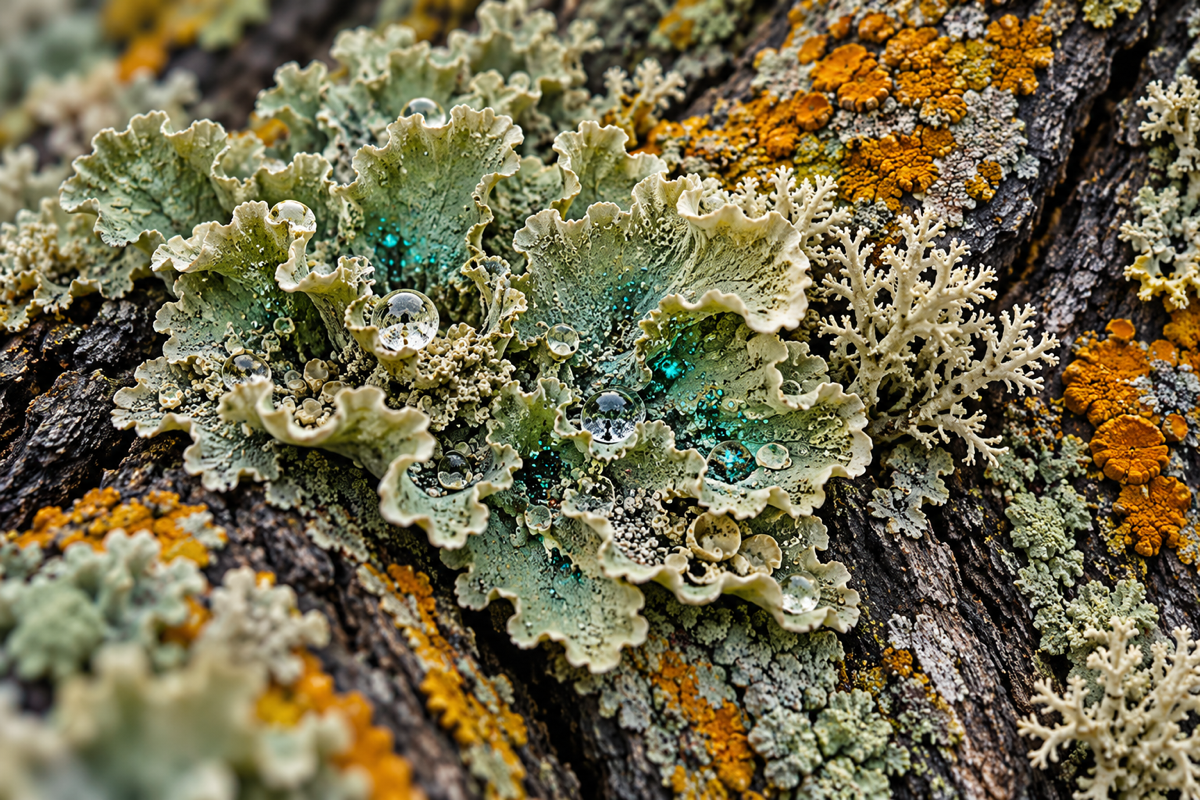
A pale green patch on a branch can look like something has gone wrong. Perhaps it has a crinkled edge, a dusty surface, or little shapes that resemble miniature cups. Once you notice it, you begin finding similar patches on the fence, an old pot, and another tree nearby.
Some of those patches may be lichens. They are easy to overlook while leaves and flowers hold our attention, then surprisingly absorbing when the garden becomes quieter.
Before reaching for a brush or treatment, it helps to know what you are looking at. Lichen on bark is generally harmless to the tree, and its presence alone does not tell you the tree is ill.
What Is a Lichen?
A lichen is a partnership involving a fungus and a photosynthetic partner, such as a green alga or a cyanobacterium. The photosynthetic partner can use light to produce food, while the fungal structure provides a place for the association to live.
That is different from imagining a single tiny plant rooted into the bark. The tree provides a surface on which the lichen grows.
The Royal Horticultural Society explains lichens on trees and shrubs and distinguishes them from other growths gardeners may notice. Knowing that several different things can share the same trunk is a good starting point for looking more carefully.
Three Shapes to Look For
Lichens come in many forms. A useful first exercise is to describe the structure before trying to name the species.
Crust-like patches sit closely against their surface. From a distance, they can resemble splashes of paint. Look at the boundary of a patch and see whether you can distinguish its edge from the bark beneath it.
Leaf-like forms have lobes or flattened sections that can look loosely attached around their edges. The overall patch might remind you of a tiny ruffled rosette.
Shrubby or hanging forms grow in more branching, three-dimensional shapes. Depending on what occurs in your area, you might notice small tufts or strands.
These broad forms are a way to begin observing. They are not successive stages that every lichen must pass through, and they do not provide a complete identification by themselves. Color alone is not enough either: several different lichens may share similar shades.
Is It Feeding on the Tree?
This is the question that worries many gardeners. Lichens growing on bark are not taking food from the tree as a parasite would.
The University of Maryland Extension describes lichens as non-destructive. A healthy tree can support lichens, and finding them does not automatically create a problem that needs treatment.
There is a complication worth understanding. Lichens may also be conspicuous on a tree that is already growing poorly. Slower growth and changes in the canopy can create conditions in which they become more noticeable. That does not mean they caused the decline.
If the tree has dying branches, unusual leaf loss, or other symptoms, investigate those separately. Treating the visible lichen would miss the question of what is affecting the tree itself.
Moss, Algae, and Lichen Are Different
A green trunk does not necessarily have just one kind of growth on it. Moss, algae, and lichens can occur in the same general area, and a photograph from several steps away may not show enough detail to separate them confidently.
Moss often forms recognizable leafy tufts or cushions. Algae may appear more like a coating. Lichens can have the crusty, lobed, or branching structures described above, but identification still takes care.
Use a magnifying glass if you have one. Compare texture and shape without peeling anything away. If you need a definite identification, take clear photographs and consult a suitable local resource or expert.
A useful photograph includes both a close view and a wider picture showing the surface and surroundings. Record whether the growth is on bark, stone, or woodwork, since that context can help.
A Small Looking Exercise
Choose a patch at a comfortable viewing height. Spend a minute finding its outer edge, then look toward the center.
Can you see separate lobes? Small discs? A change in color? Is the underlying bark smooth or deeply ridged?
Write down what you can actually distinguish. “Gray-green patch with curled edges” is a useful observation even if you never discover its name. A simple sketch can help you remember the shape more clearly than a long description.
You can repeat the exercise with a different patch nearby. Avoid assuming they are the same species because they share a color or occupy the same tree.
This approach fits well with a restful nature walk: choose a small feature, give it a little time, and let the detail provide the interest.
Let the Pattern Stay Where It Is
For ordinary harmless lichen on a tree, removal is generally unnecessary. Scraping bark to make it look clean can create damage while removing something that was not harming the tree in the first place.
Enjoy the growth in place. If you photograph it, leave the patch intact for the next person who might stop to look.
The same surface can offer creative inspiration too. A lichen's ruffled outline might suggest the edge of a fairy cloak, or its colors might become the palette for a drawing. Keep the distinction clear: the imagined design comes from your response to a real organism.
Readers who enjoyed Foxgloves in Folklore and Fantasy Gardens may recognize that pleasure of letting a real detail prompt an imaginative one.
Next time you pass the tree, you may find yourself looking at its bark before looking up into its branches. The patch you first noticed as a possible problem can become a familiar part of the garden, with enough detail to reward another visit.