How Dragonflies Hunt and Why They Matter Near Water and Gardens
Learn how dragonflies hunt with remarkable speed and precision, and why they matter so much in ponds, wetlands, and summer gardens.
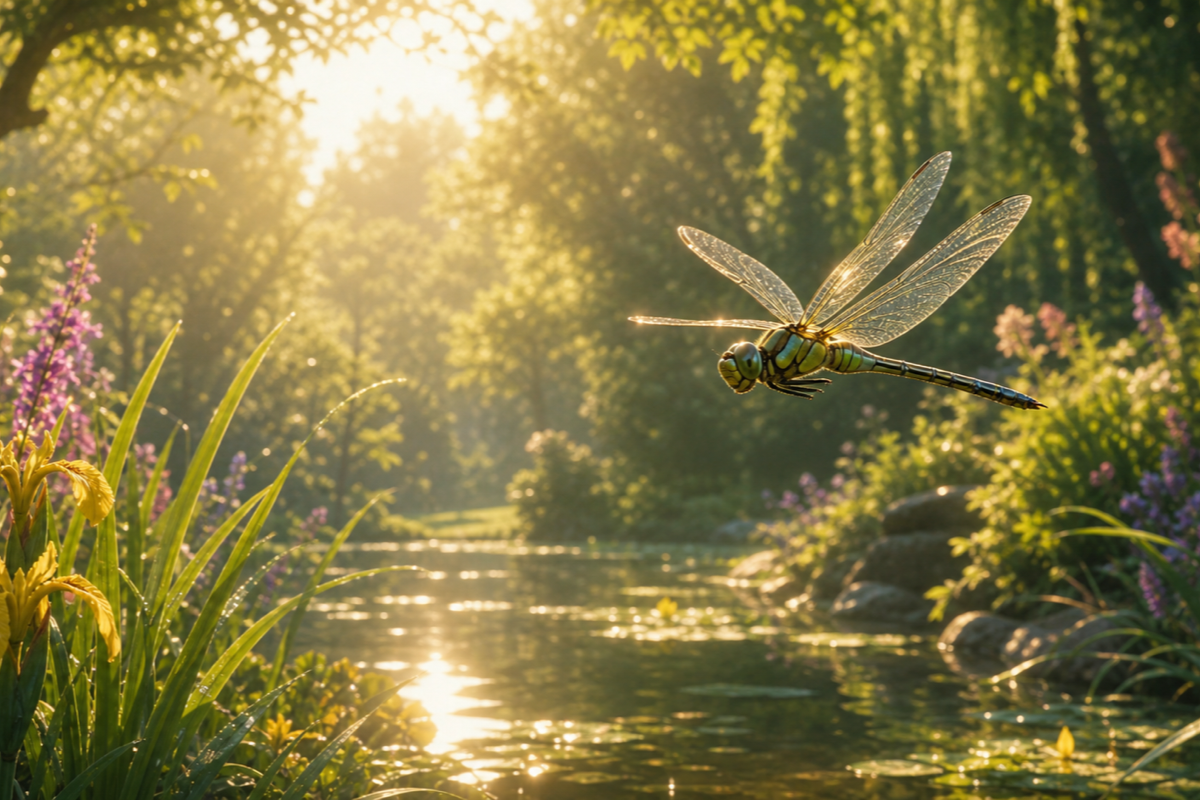
Dragonflies can make flight look almost unreal.
They turn sharply, hover in place, reverse direction, and skim over ponds or gardens with a kind of speed that feels more like intention than movement. There is nothing clumsy about them. They seem built for accuracy.
That is because they are.
Dragonflies are among the most skilled insect hunters in the natural world. Their flight control, vision, and timing allow them to catch prey in midair with extraordinary success. And their presence in a landscape often means more than many people realize. Dragonflies are not only beautiful summer visitors. They are signs of active ecosystems, especially where water, insects, and plant life meet.
If you have enjoyed nature pieces like How Bees Find Flowers and Why Their Work Matters So Much or How Butterflies Find Flowers Using Color, Scent, and Sunlight, dragonflies belong in that same world of small creatures doing remarkable work.
Dragonflies Are Built for Hunting
Dragonflies do not simply drift around water because it looks pretty.
They are active predators. Both as adults and in their earlier aquatic stage, they hunt other small creatures for food. Adult dragonflies catch flying insects such as mosquitoes, gnats, midges, and flies. Their bodies are designed to help them do this with exceptional efficiency.
They have:
- large compound eyes for nearly all-around vision
- strong wings that can move independently
- slender but powerful bodies built for speed
- legs that form a kind of basket to scoop prey in flight
This makes dragonflies highly effective aerial hunters. They do not need to wait for prey to come close. They can pursue it, predict its movement, and intercept it with stunning control.
Their Eyes Make a Huge Difference
One of the most impressive parts of a dragonfly is its vision.
A dragonfly's eyes take up a large portion of its head, allowing it to detect motion and track prey with remarkable accuracy. These compound eyes contain thousands of tiny visual units, helping the insect notice movement quickly and respond almost instantly.
For a hunter that works in open air, this matters enormously.
Many flying insects move unpredictably. A predator that depends on catching them mid-flight needs to notice not only where prey is, but where it is about to be. Dragonflies are exceptionally good at this. Some research suggests they do not simply chase randomly. They can predict and intercept.
That makes their movement look smooth, even when it is highly strategic.
Dragonflies Hunt in the Air
Unlike insects that feed from flowers or surfaces, dragonflies do much of their hunting on the wing.
They patrol over ponds, streams, marshy edges, meadows, and gardens, especially in warm weather. Once they detect prey, they can accelerate quickly, adjust direction almost instantly, and catch the insect without needing to land.
This is where their famous flight skills become so important.
Dragonflies can:
- hover like tiny helicopters
- move upward or downward rapidly
- turn sharply
- glide and then surge forward
- pause in air before changing direction
That maneuverability is part of what makes them so fascinating to watch. Their flight looks elegant, but it is deeply practical. Every quick turn and hover can be part of a hunting decision.
They Help Control Mosquitoes and Other Insects
One reason dragonflies matter so much near water and gardens is that they feed on insects people often consider pests.
Adult dragonflies eat many small flying insects, including mosquitoes. Their aquatic young, called nymphs, also hunt actively underwater, feeding on larvae and other small creatures. This means dragonflies are useful predators in more than one stage of life.
It would be too simple to say dragonflies solve every mosquito problem on their own, but they are certainly part of the natural balance that helps keep insect populations from growing unchecked.
That role is worth appreciating.
Dragonflies are not only attractive visitors. They are active participants in how summer ecosystems regulate themselves.
Dragonflies Begin Life in Water
One of the most interesting things about dragonflies is that much of their life happens out of sight.
Before they become the fast, glimmering adults we notice in summer, dragonflies live underwater as nymphs. In this stage they are already hunters, feeding on insect larvae, tadpoles, and other small aquatic life.
Some species remain in this aquatic stage for months or even years before emerging as adults.
This is one reason dragonflies are so closely tied to healthy water systems. If you are seeing dragonflies regularly, especially around ponds or wet habitats, that often suggests the surrounding environment is supporting a more complete cycle of life than it may appear to at first glance.
Water, vegetation, prey, and seasonal rhythm all need to work together.
Why Dragonflies Love Ponds and Gardens
Dragonflies are especially drawn to places where food, warmth, and water come together.
Ponds are natural centers of activity because they support the aquatic stage of the life cycle. But gardens can also attract adult dragonflies, especially if there is nearby water, abundant insect life, sunny perches, and open airspace for flight.
This is why a garden near water can feel especially alive in summer. Bees visit flowers. Butterflies drift between blooms. And dragonflies patrol the air with a completely different kind of purpose.
That layered activity gives a place ecological richness. It makes the landscape feel inhabited from multiple directions at once.
If you enjoy that sense of lively beauty, you may also like Late Spring Gardens and the Quiet Magic of May and the visual storytelling in Gallery of the Stars.
Dragonflies Are Ancient Insects
Dragonflies belong to a very old lineage.
Their ancestors existed long before humans, and prehistoric relatives once grew to astonishing sizes. While modern dragonflies are much smaller, they still carry something ancient in the way they move. Their bodies seem highly refined for a job they have been doing for a very long time.
That is part of their appeal.
Watching a dragonfly can feel like looking at a design that has already solved its own problem. Speed, balance, eyesight, and purpose are all working together with almost no wasted motion.
Nature often feels magical when it is this precise.
What Dragonflies Tell Us About Ecosystems
Because dragonflies depend on both water and surrounding habitat, their presence can tell us something useful about the health of a place.
A dragonfly-friendly environment usually needs:
- water that can support larvae
- nearby insect populations for food
- vegetation or surfaces for resting
- warm sun for activity
- enough habitat continuity for the life cycle to complete
This is one reason dragonflies can be thought of as small indicators of ecological quality. They are not the only measure, but they are often part of a larger picture.
When dragonflies are present, it often means a landscape is offering more than surface beauty. It is functioning.
Why People Are So Drawn to Them
Dragonflies are biologically impressive, but they are also emotionally compelling.
Part of that comes from movement. Their flight is hard to ignore. Part comes from appearance. Their wings catch light in a way that makes them seem almost made of glass and air. And part of it comes from the settings where we often see them: summer ponds, garden edges, reeds, sunlit water, and warm quiet afternoons.
These are already atmospheric places.
The dragonfly adds energy without breaking the calm. It feels vivid, but never noisy.
That balance is rare and beautiful.
Small Hunters, Big Importance
Dragonflies hunt so well because they are built for precision: strong vision, agile flight, quick response, and a body designed to catch prey in motion. They matter because that hunting helps shape the insect world around ponds, wetlands, and gardens.
They are not just decorative signs of summer.
They are working creatures in a living system.
The next time one flashes past you over water or hovers for a second above a garden path, it is worth remembering that you are seeing more than a lovely insect. You are watching one of nature's most accomplished little hunters at work.
That makes summer feel even more alive.