Late Spring Gardens and the Quiet Magic of May
Discover why gardens feel most magical in late spring, when light, scent, flowers, and wildlife come together in one of the season's most beautiful moments.
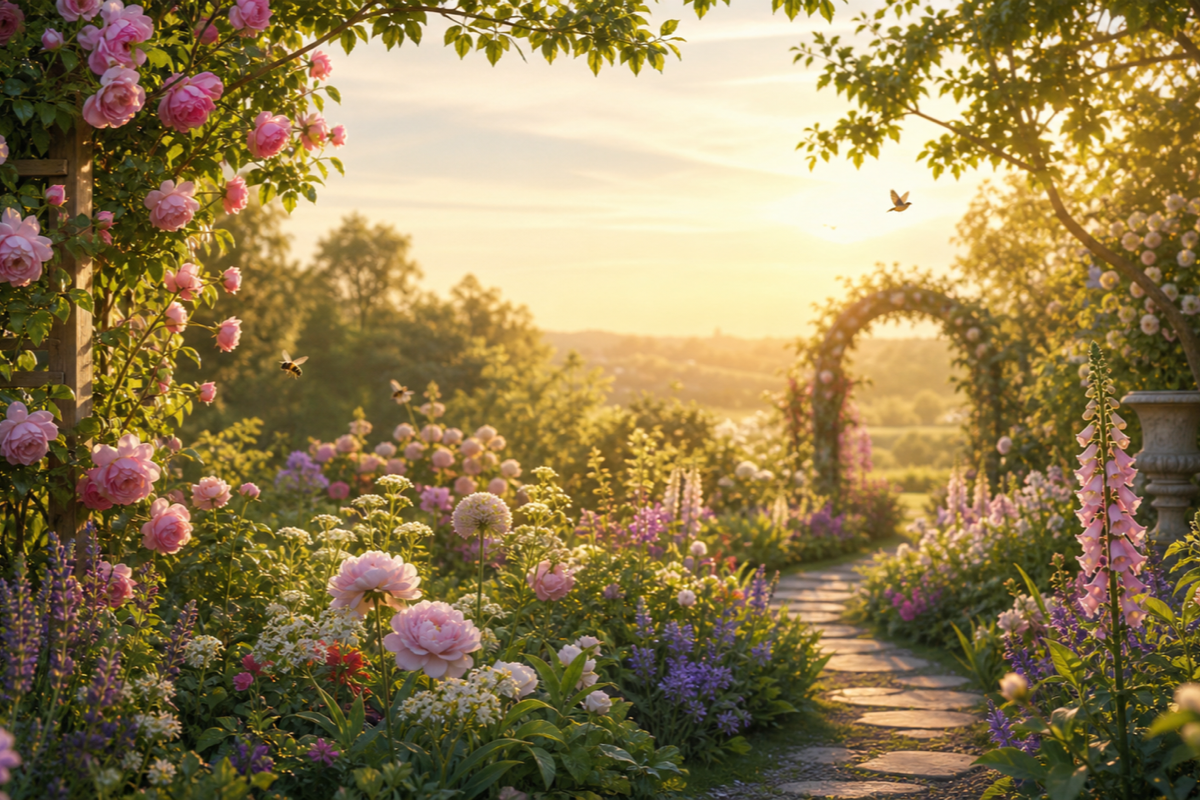
There is something about late spring that makes even an ordinary garden feel as though it is quietly becoming a story.
By this point in the season, the first excitement of early bloom has settled into something fuller and richer. The air feels softer. The light lingers longer. Leaves have opened enough to create shelter and depth. Flowers no longer appear one by one like cautious announcements. They arrive in layers, color beside color, scent beside scent, movement beside movement.
A garden in late spring does not just look alive. It feels inhabited.
Bees move with purpose. Butterflies drift through the edges of sight. Birds seem busier in the hedges. Petals loosen in warm air. Greenery deepens, and the whole space begins to feel less like a collection of plants and more like a small world with its own rhythm.
That is why so many people describe late spring gardens in almost magical language. Even if they are not particularly fanciful by nature, they start talking about enchantment, hidden corners, secret beauty, and the sense that the garden is somehow more itself during this part of the year.
And perhaps they are right.
Not because the garden has literally crossed into another realm, but because late spring is the moment when nature often feels most generous, expressive, and complete without yet becoming heavy with summer.
If you have enjoyed more reflective pieces like From Harvest to Hibernation: Embracing the Rhythms of Nature (and Ourselves) or whimsical seasonal writing like The Garden That Refused to Sleep, this is very much part of that same world of seasonal wonder.
Late Spring Feels Full Without Feeling Overgrown
One reason late spring feels so special is balance.
Early spring has freshness, but it can still feel spare. Summer has abundance, but it can sometimes become intense, hot, or overfull. Late spring sits beautifully between those two moods.
By late spring, plants have had enough time to leaf out and settle in. Flowering is more confident. The structure of the garden becomes visible again, but now it is softened by fullness. Paths feel edged rather than bare. Borders feel generous rather than newly planted. Trees and shrubs begin to create shade, which changes not only how a garden looks, but how it is experienced.
This is often the point when a garden starts feeling less like work and more like atmosphere.
That shift matters. A magical-feeling space is rarely one that looks newly arranged. It is usually one that feels as though it has grown into itself.
The Light Changes Everything
Late spring light plays a huge role in the mood of a garden.
By May, the days are longer and the sun sits differently in the sky than it did in the earliest part of spring. Morning light feels clearer. Evening light feels warmer. There is more time each day for the soft golden hours that make leaves glow from behind and flowers seem almost lit from within.
This kind of light creates atmosphere almost effortlessly.
A simple patch of foxglove or roses can look theatrical in late afternoon. A shaded path can feel secretive rather than dark. A border full of green foliage suddenly gains depth because light is filtering through different layers of leaves instead of falling flat across the ground.
People often think of gardens as collections of plants, but light is one of the most important ingredients in how a garden feels. In late spring, that ingredient becomes especially generous.
Scent Is Stronger in Late Spring Too
A magical garden is not only something we see. It is also something we smell.
Late spring often brings some of the most memorable garden scents of the year. Blossoms are open, the air is warmer, and many flowers begin releasing fragrance more fully in this season. Jasmine, roses, lilac, honeysuckle, and herb borders can all make the air itself feel richer.
Scent changes a space in a very personal way.
You can admire a beautiful garden from a distance, but the moment you step into a scented one, the experience becomes immersive. It is no longer scenery. It is atmosphere.
That may be one reason late spring feels so emotionally powerful. Fragrance has a way of blending memory with the present. A garden can feel magical partly because it seems to exist in more than one time at once, holding this evening and ten older ones in the same breath.
Wildlife Makes the Garden Feel Alive
Late spring is often when gardens begin to feel fully inhabited by small life.
Bees visit flowers more steadily. Butterflies become more visible. Birds move between branches, fences, and feeders with a kind of purposeful energy that makes the whole place feel active. Even the quieter details, like the hum near blossoms or the quick rustle in a hedge, begin to add up.
This matters more than people sometimes realize.
A beautiful garden can still feel a little still if nothing is moving through it. The presence of wildlife gives a garden personality. It creates the feeling that the space is not merely decorated, but functioning as part of a larger living world.
That is one reason late spring often feels more magical than a perfectly manicured but empty garden. Life is participating.
If you enjoy noticing that kind of natural liveliness, you may also like The Secret Architects: Animals That Build Incredible Homes or the visual storytelling of Gallery of the Stars.
Growth Has Not Yet Become Exhaustion
Another reason late spring feels different is that growth still feels joyful.
By midsummer, gardens can begin to demand more from both plants and people. Heat rises. Watering matters more. Blooms begin to fade in some places while others struggle to keep up. Late spring has not usually reached that point yet.
There is still a sense of ease in the growth.
Plants seem to be rising into themselves rather than enduring. Leaves still look fresh. New color keeps appearing. The season feels expansive rather than tired.
That emotional freshness is part of what gives late spring its magical quality. The garden feels abundant, but not burdened. Alive, but not stressed. Full, but not crowded.
Late Spring Encourages Slower Attention
A garden often feels magical when it helps us notice more than we normally would.
Late spring is especially good at this. The combination of scent, soft weather, longer evenings, and visible life encourages a different kind of attention. People linger more. They sit outside longer. They notice smaller details, such as how a flower has opened since yesterday or how one corner of the garden catches evening light.
This is part of why late spring can feel restorative as well as beautiful.
It invites presence without forcing it.
You do not need a grand estate for this effect. Even a small courtyard, patio, or patch of blooms near a walkway can create it if the season is doing its work well.
Late spring reminds us that magic often begins not with extravagance, but with attention.
Why Hidden Corners Feel More Enchanted in May
Almost every garden has one place that feels slightly secretive.
It may be a bench under a tree, a narrow side path, a climbing rose near a wall, or a shaded corner where ferns and flowers meet. In late spring, these spaces often become especially compelling because the season has softened their edges.
More leaves mean more privacy.
More flowers mean more invitation.
More warmth means more time spent outdoors.
The result is that tucked-away parts of a garden begin to feel less overlooked and more discovered.
This is one reason gardens and fantasy belong together so naturally. The best gardens create the feeling that not everything must be seen at once. Some beauty is better approached slowly.
That same spirit lives in your more imaginative sections too, from Fairies to Fairy Sets and Magical Trees.
The Season of Promise
Late spring also carries emotional meaning beyond what is physically visible.
It is a season of promise. Summer is near, but not yet fully here. The garden looks strong, but still tender in places. There is enough bloom to feel rewarded, yet still enough unopened life to feel expectant.
That combination creates a powerful mood.
We are drawn to moments that feel full of both presence and possibility. Late spring offers exactly that. The garden is already beautiful, but it also suggests that more is coming. That anticipation adds depth to the experience.
Perhaps that is one reason late spring gardens feel so memorable. They are not only lovely. They are hopeful.
Why Gardens Feel Like Small Worlds
When people describe gardens as magical, they are often responding to the fact that a good garden feels like its own contained world.
It has rhythm, mood, edges, inhabitants, and a sense of internal life. You step into it and the outside pace changes. Sound softens. Attention sharpens. Time feels slightly different.
Late spring strengthens that effect because everything in the garden is participating at once. The plants, the light, the wildlife, the scent, and the weather all seem to agree on what kind of place this is meant to be.
That harmony is rare.
And when it appears, even briefly, it feels enchanted.
Why Late Spring Leaves Such a Strong Impression
Gardens feel most magical in late spring because the season brings together so many forms of beauty at once without yet tipping into heaviness.
The light is kind.
The air is softer.
The flowers are generous.
Wildlife is active.
Growth feels confident but not exhausted.
And all of it encourages us to pay better attention.
In the end, that may be the deepest reason late spring feels magical. It helps us notice the world as if it still has secrets to offer.
And a good garden, at the right moment in May, absolutely does.