The Quiet Night: What Wildlife Is Doing While We Celebrate Christmas Eve
Discover what wildlife is doing while we celebrate Christmas Eve — owls hunting, foxes moving through snow, whales migrating under moonlit waves.
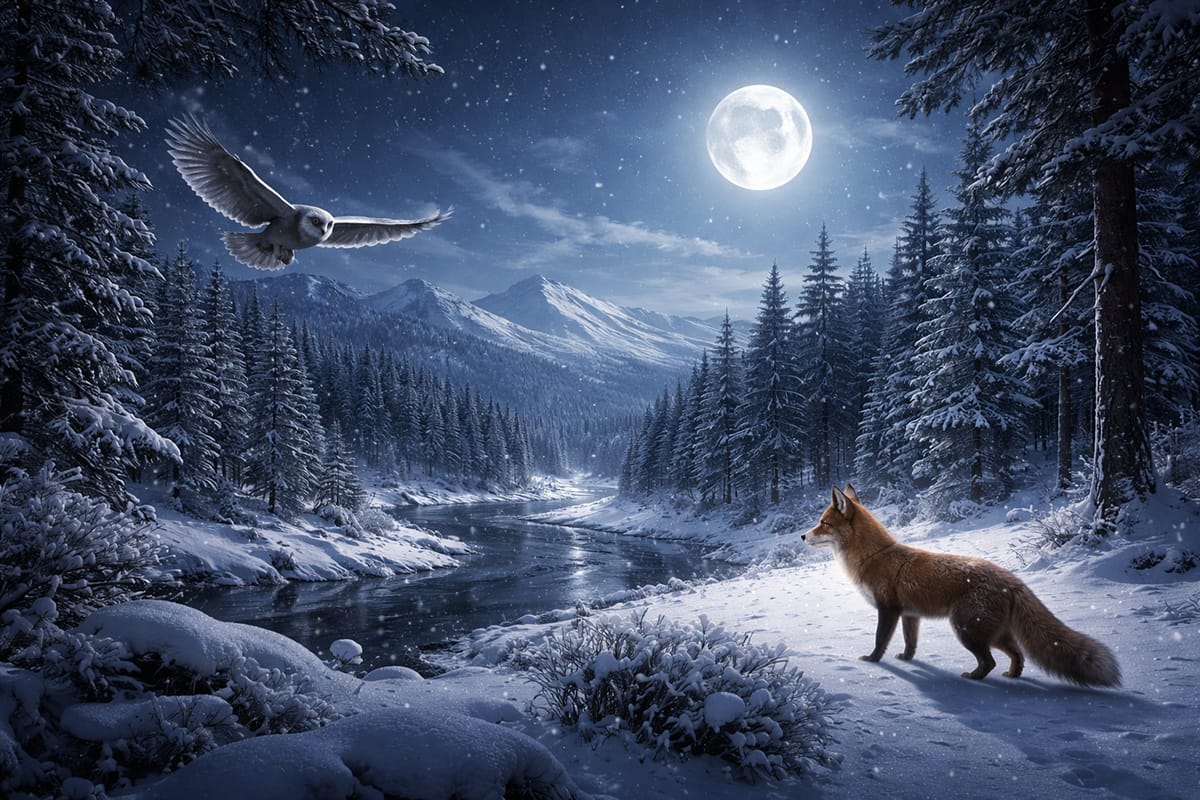
While houses glow with warm lights and voices drift through open windows, the natural world is doing something very different.
It is quiet.
Christmas Eve arrives at the deepest, darkest stretch of winter for much of the world. The celebrations happen indoors, but outside — in forests, fields, oceans, and skies — life continues its ancient rhythms. Not loudly. Not urgently. Just steadily.
This is a night of movement without spectacle. Of rest without sleep. Of survival carried out softly, beneath stars and moonlight.
Let’s step outside the human story for a moment and look at what wildlife is doing while we celebrate Christmas Eve.
A Night Built for Listening
Winter nights change the world’s soundscape. Snow absorbs noise. Cold air carries sound farther but softens it at the same time. The result is a hush that feels almost sacred.
For animals, this quiet is not empty. It’s information.
Owls hear mice beneath the snow. Foxes detect subtle movement in frozen grass. Deer sense pressure shifts, scents, and vibrations long before danger appears.
Christmas Eve isn’t silent. It’s attentive.
In the Forest: Shadows Moving Softly
Owls on the Wing
For owls, this is prime time.
Great horned owls, tawny owls, and snowy owls glide through winter forests and open fields, their feathers designed to make no sound at all. Their hearing is so precise they can locate prey hidden beneath thick snow — guided by rustles too faint for human ears.
While people toast and sing indoors, an owl may complete several hunts before dawn, sustaining itself through the coldest season of the year.
Foxes in the Snow
Foxes are winter specialists. On Christmas Eve, red foxes and Arctic foxes move with deliberate care, conserving energy while staying alert.
You might spot one pausing in a snowy clearing, ears rotating independently, listening. Then — a sudden leap. They plunge headfirst into snow to catch rodents below, using techniques refined over thousands of winters.
The world may look still, but for foxes, it’s a map of hidden motion.
Deer at Rest
Deer conserve energy during winter nights. Rather than roaming endlessly, they bed down in sheltered areas, often beneath conifers where snow accumulation is lighter.
They remain alert even while resting. Muscles stay primed. Ears flick. Breathing slows.
This isn’t sleep in the human sense — it’s survival-mode calm.
Fields and Hedgerows: Life Between the Frost
Open landscapes may seem empty on Christmas Eve, but they’re full of subtle life.
- Rabbits emerge cautiously to feed on exposed vegetation.
- Voles and mice tunnel beneath snow, insulated by air pockets that protect them from freezing.
- Weasels slip through narrow pathways, hunting with relentless efficiency.
Snow becomes both shelter and danger. It hides movement but also preserves scent trails. Every step is calculated.
Winter doesn’t pause ecosystems. It compresses them.
Above the Trees: Winter Skies at Work
Migratory Birds Passing Through
Not all birds are gone.
Some species migrate under the cover of night, navigating by stars, Earth’s magnetic field, and moonlight. Christmas Eve may find flocks passing high overhead, unseen by most humans — quiet travelers crossing continents.
Others, like ravens and crows, roost communally. Large groups gather in sheltered areas, sharing warmth and safety through numbers.
The Moon’s Role
Moonlight matters. It shapes hunting success, visibility, and risk.
- Predators hunt more efficiently.
- Prey become more cautious.
- Shadows stretch longer across snow-covered ground.
Christmas Eve moonlight often feels brighter because of reflection from snow — a natural illumination that has guided wildlife long before electric lights existed.
Beneath Frozen Lakes and Rivers
Water does not go silent in winter.
Under ice, fish continue to move, though more slowly. Oxygen levels shift. Metabolisms adjust.
Some fish rest in deeper water where temperatures remain stable. Others move cautiously near vegetation.
Beavers remain active beneath ice, traveling between lodges and food caches. Otters slide through icy channels, playful even in cold conditions.
Winter water worlds are quieter — not lifeless.
The Oceans: Migration Under Moonlit Waves
Far from snowy forests, Christmas Eve unfolds differently — but just as quietly — in the sea.
Whales on the Move
Many whale species migrate during winter months, traveling thousands of miles to breeding or calving grounds. Christmas Eve may find humpbacks, gray whales, or right whales moving steadily through dark waters.
They navigate by sound, memory, and subtle environmental cues. Beneath moonlit waves, their journeys continue — slow, massive, purposeful.
Bioluminescent Companions
In some waters, microscopic organisms glow when disturbed, leaving faint trails of light behind passing animals. Even in darkness, life leaves signatures.
The ocean doesn’t sleep on Christmas Eve. It breathes.
In the Coldest Places on Earth
Arctic Life
For Arctic animals, Christmas Eve may fall during near-total darkness.
- Polar bears patrol ice edges.
- Arctic foxes follow larger predators, scavenging leftovers.
- Reindeer dig through snow for lichens, guided by senses adapted to darkness.
Life here is stripped to essentials. Energy is precious. Every movement matters.
Why Stillness Matters
Winter teaches restraint.
Animals don’t waste energy celebrating or rushing. They rest when possible. They move when necessary. They listen more than they act.
There’s wisdom in that.
Christmas Eve, with all its warmth and noise, exists alongside a quieter truth: the planet keeps going, gently, without spectacle.
What We Miss Indoors
While we gather around tables and screens, entire ecosystems are active just beyond our doors.
- Tracks appear and vanish overnight.
- Wings cut through cold air.
- Breath fogs under starlight.
None of it asks for attention. None of it pauses for holidays.
And yet, this quiet continuity is what keeps the world alive.
A Night Shared, Even If Unnoticed
Humans don’t own Christmas Eve. We simply experience it differently.
We light candles. Wildlife reads moonlight.
We rest in warmth. Animals balance survival and stillness.
We mark the night with tradition. Nature moves through it as it always has.
Under the same stars, life continues — quietly, patiently, beautifully.
Taking the Quiet With You
If you step outside tonight, even briefly:
- Listen longer than you speak.
- Look for movement, not spectacle.
- Notice how alive the stillness feels.
Christmas Eve doesn’t belong only to us.
It belongs to owls and foxes, deer and whales, rivers under ice and skies full of unseen wings.
And maybe that makes it even more special.