Hidden Gardens in Fantasy Stories: Beauty, Secrecy, and Wonder
Explore why hidden gardens appear so often in fantasy stories, and how they combine beauty, secrecy, healing, and wonder.
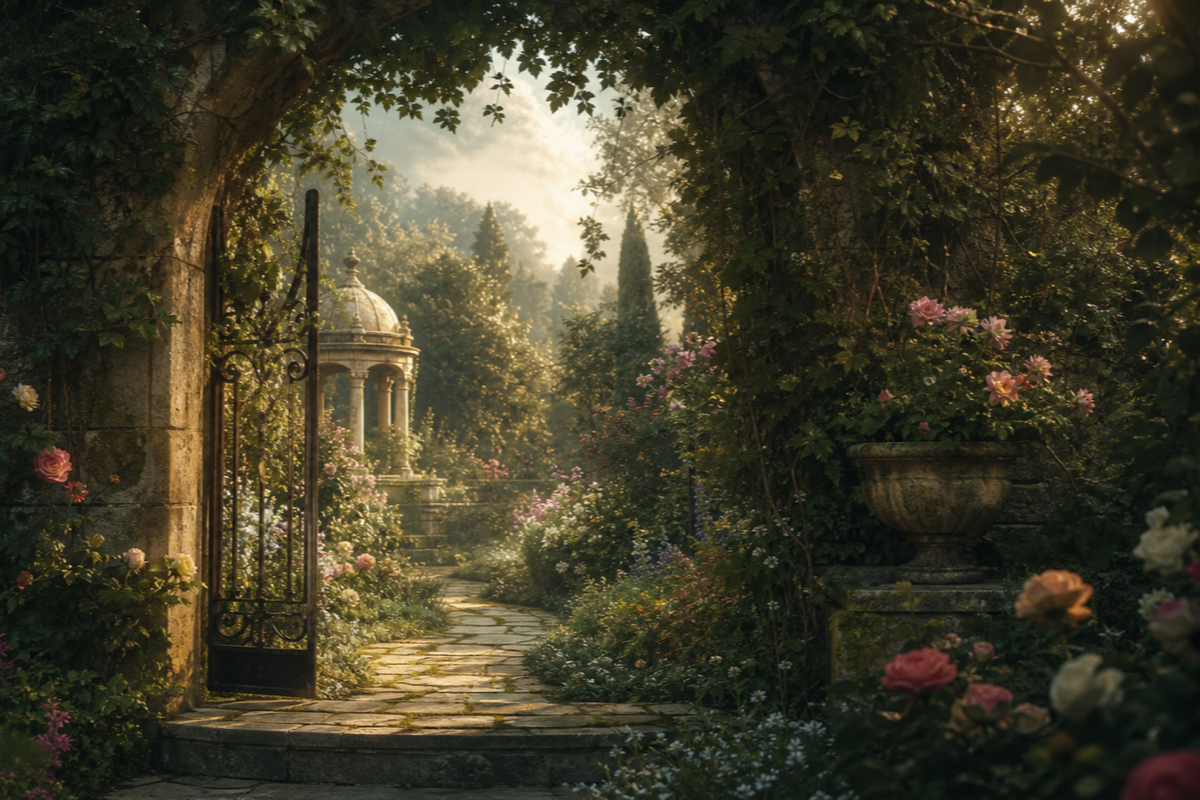
Some fantasy settings dazzle immediately.
They arrive with dragons, castles, portals, or impossible skies. Hidden gardens work differently. They are quieter than that. They do not usually overwhelm the story when they appear. Instead, they create the feeling that something secret, protected, and deeply meaningful has been waiting just beyond ordinary sight.
That is one reason hidden gardens appear so often in fantasy stories.
They combine beauty with discovery. They feel private without feeling empty. They suggest that wonder has roots, that enchantment can be cultivated, and that some places are not meant to be stumbled across by everyone.
Unlike a battlefield or a throne room, a hidden garden does not usually exist to display power in a loud way. Its power is gentler. It restores, shelters, reveals, and transforms. In fantasy, that can be even more compelling than spectacle.
And the truth is, hidden gardens already feel magical even outside fiction. A tucked-away path, a walled courtyard full of climbing flowers, a green corner behind old stone, or a quiet place where blooms seem to gather without showing themselves all at once can make people feel as though they have crossed into a world that rewards attention.
If you have enjoyed posts like Why Forest Paths Feel Like Portals in Fantasy Stories or The Hidden Door in the Forest: Why Forests Feel Magical in Folklore, Fantasy, and Real Life, hidden gardens belong beautifully in that same imaginative tradition.
Hidden Gardens Combine Mystery and Safety
One reason hidden gardens work so well in fantasy is that they balance two emotional qualities people love: mystery and safety.
Many magical settings lean strongly toward one or the other. A dark forest may be mysterious but dangerous. A sunny kingdom may be safe but not especially secretive. A hidden garden sits in a different emotional space. It feels secluded, protected, and quietly charged with meaning.
That combination makes it powerful.
Readers are drawn to places where something important might be revealed without the setting itself becoming immediately threatening. A hidden garden can hold memory, healing, truth, old enchantments, or private transformation while still feeling beautiful enough to enter willingly.
In other words, it invites trust even while keeping secrets.
Why Gardens Feel Different From Wild Magic
Fantasy often includes wild enchanted landscapes, but gardens create a different feeling from forests, mountains, or moors.
A garden suggests care.
Even when it has become overgrown, it still implies intention somewhere in its history. Someone planted here. Someone protected this place. Someone believed beauty should be gathered, shaped, and allowed to flourish.
That changes the emotional meaning of the magic.
Wild magic can feel ancient, unpredictable, and untamed. Garden magic often feels intimate. It belongs to patience, memory, return, and quiet cultivation. The enchantment is not only in what grows there, but in the fact that it has been kept, hidden, or preserved.
This is one reason hidden gardens are so often linked to healing, lost stories, old family lines, or places of emotional awakening in fiction.
Hidden Gardens Reward the Right Kind of Character
Not every character finds the hidden garden.
That is part of its power.
Usually, these places reveal themselves to someone who is lonely, observant, wounded, curious, gentle, or ready for change. The hidden garden is rarely discovered by the loudest person in the story. It tends to open itself to the character who notices, lingers, or needs restoration.
This makes the setting feel almost morally selective.
The garden does not only hide from the world. It waits for the right encounter.
That is deeply satisfying in fantasy because it suggests that wonder is not random. It can be relational. It can respond to character.
Readers often love that feeling because it turns discovery into a kind of recognition. The character finds the hidden garden, but the hidden garden also seems to have been waiting for that character.
Why Hidden Gardens Often Symbolize Healing
Hidden gardens are frequently tied to healing in fantasy and children's literature, and for good reason.
A garden is a place of growth, patience, tending, and gradual change. When hidden, it adds privacy and emotional safety. This makes it a natural symbol for recovery that is quiet rather than dramatic.
Characters who enter hidden gardens often begin to change there.
They become calmer.
They remember something important.
They begin to trust again.
They reconnect with beauty after grief, fear, or numbness.
This symbolism feels intuitive because gardens themselves already embody renewal. They move through death and bloom, barrenness and return, season after season. Fantasy simply turns that natural rhythm into narrative meaning.
Why Beauty Feels More Powerful When It Is Discovered
Part of the magic of a hidden garden is that it is not immediately available.
Beauty often feels more meaningful when it is discovered rather than displayed. A garden behind walls, under vines, beyond a gate, or at the end of a narrow path feels personal in a way an open public view does not.
This does not make one kind of beauty better than another. It simply creates a different emotional response.
Discovery creates attachment.
The reader or character feels they have entered into relationship with the place. The garden becomes not just beautiful, but found.
Fantasy thrives on this kind of feeling because it turns setting into experience. The hidden garden is not only admired. It is uncovered, entered, and remembered.
If you enjoy imaginative spaces that feel intimate rather than grand, you may also like Fairies, Fairy Sets, and Meet My Characters, where wonder often lives in the details rather than spectacle alone.
Why Hidden Gardens Feel Timeless
Another reason hidden gardens work so well in fantasy is that they seem to exist slightly outside normal time.
They may be overgrown but still blooming. They may preserve a forgotten history. They may feel untouched even though seasons have passed. This gives them a suspended quality, as though the world moved on without fully claiming them.
That timelessness is especially potent in fantasy.
It allows the garden to hold memory in a visible form. Old roses can suggest an old promise. Moss on a wall can suggest years of silence. A still fountain, a locked gate, or a flowering tree can carry emotional weight without needing much explanation.
The setting itself begins to speak.
And because gardens are made of living things, that speech feels softer and more poignant than stone ruins alone.
Hidden Gardens and the Fantasy of Attention
At heart, the hidden garden is about more than flowers.
It is about the idea that some of the world's most meaningful beauty is not obvious at first glance. It must be approached, noticed, or entered with care.
This is one of the most enduring fantasies people carry: that there are places of wonder still waiting to be found, and that these places are not reserved for the powerful but for the receptive.
The hidden garden expresses that fantasy perfectly.
It says beauty can be protected without disappearing.
It says gentleness can still be powerful.
It says some doors open not with force, but with patience.
No wonder readers keep returning to it.
Why We Keep Wanting These Places
Perhaps hidden gardens appear so often in fantasy because people genuinely long for spaces like them.
Not always literal gardens, though those are lovely too. Sometimes what people really long for is a place that feels sheltered from noise, full of life, and capable of changing them without demanding performance first.
A hidden garden promises exactly that.
It is beauty with privacy.
Wonder with stillness.
Growth with gentleness.
And in a noisy world, that promise can feel almost miraculous.
More Than a Pretty Setting
Hidden gardens appear so often in fantasy stories because they do important emotional work.
They create mystery without cruelty.
They support healing without becoming sentimental.
They symbolize transformation through tending, patience, and return.
And they remind readers that some of the most powerful magic in any story is not the loudest.
Sometimes it is a gate half-covered in ivy.
Sometimes it is a path that opens unexpectedly into bloom.
Sometimes it is the feeling that the world still contains places that will only reveal themselves to those willing to enter quietly.
That is not just a lovely fantasy image.
It is one people seem to need again and again.