Wildflowers at the Edge of Summer
Discover why wildflowers at the edge of summer feel so moving, and how their quiet beauty brightens roadsides, meadows, and the warm stillness of July.
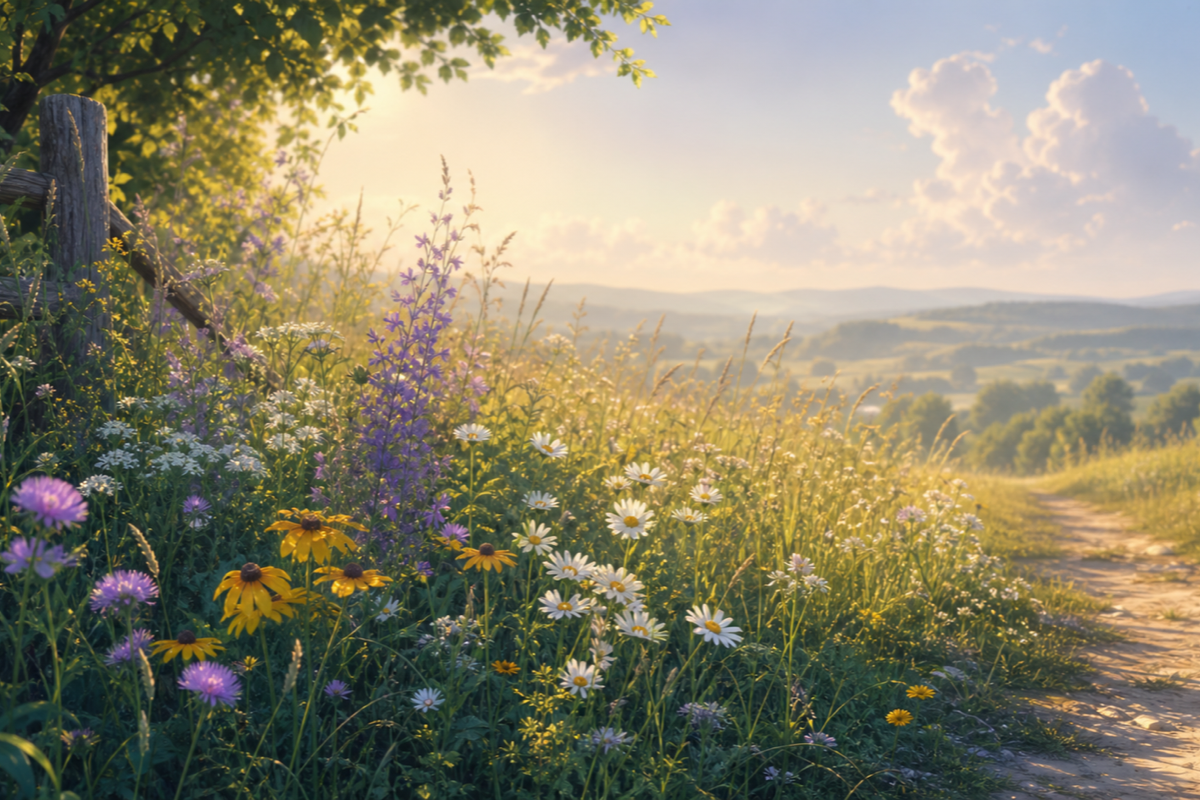
There is a particular beauty to wildflowers in midsummer that feels different from the brightness of spring.
By July, the landscape has changed. Early blossoms have faded, grasses have grown taller, and the season feels fuller, warmer, and more settled into itself. Wildflowers do not usually appear in the same fresh, eager way they do earlier in the year. Instead, they seem to belong to the land more deeply. They rise from roadsides, meadow edges, field borders, and quiet patches of uncultivated ground with a kind of confidence that feels both ordinary and quietly extraordinary.
This is one reason wildflowers at the edge of summer can feel so moving.
They are not polished garden arrangements. They are not trying to impress anyone. And yet they often create some of the most memorable summer scenes: soft purple against dry grass, yellow blooms leaning into heat, clusters of color breaking up the green and gold of a field. Their beauty is not staged. It is woven into the season itself.
If you have enjoyed reflective seasonal pieces like Late Spring Gardens and the Quiet Magic of May or A Restful Nature Walk: How to Make Time Outdoors Feel Calm Again, wildflowers belong naturally in that same world of slow, attentive summer wonder.
Wildflowers Feel Different From Garden Flowers
Part of what makes wildflowers so compelling is that they are not arranged for us.
Garden flowers often carry the beauty of care, design, and intention. Wildflowers carry something else. Their beauty feels discovered rather than presented. They appear in places that were not built to frame them perfectly, and because of that they can feel more personal when we notice them.
A roadside patch of Queen Anne's lace or black-eyed Susans can stop a person just as effectively as a carefully planted border.
Perhaps more effectively, sometimes.
This is because wildflowers often feel like evidence that beauty does not need permission to exist. It does not have to be formal in order to matter.
July Gives Wildflowers a Different Kind of Power
Spring flowers often bring excitement. July flowers bring steadiness.
By midsummer, the land is no longer just waking up. It is carrying the weight of the season. Heat has deepened colors in some places and softened them in others. Grasses have length. Trees have full canopies. The world feels more mature than it did in April or May.
That maturity changes how wildflowers look.
They seem less like announcements and more like part of a living pattern that has fully settled into place. Their beauty can feel quieter, but also deeper. A single stand of summer blooms beside a path may not shout for attention, but it often rewards longer looking.
This is one reason July can be such a strong month for noticing the emotional side of nature. The landscape is not only pretty. It is textured with time.
Wildflowers Support More Than Beauty
One of the best things about wildflowers is that their value goes beyond appearance.
They help support bees, butterflies, moths, and many other insects. They provide nectar and pollen, add diversity to local habitats, and can keep roadsides, meadows, and open land far more ecologically alive than they might seem at first glance.
This is especially important in summer, when pollinators are active and need dependable floral resources.
A field of wildflowers is not only a lovely sight. It is a working part of an ecosystem.
If you enjoyed How Bees Find Flowers and Why Their Work Matters So Much or How Butterflies Find Flowers Using Color, Scent, and Sunlight, wildflowers are part of the same story. Beauty and usefulness live side by side there.
They Make the Edges of Places Feel Alive
Wildflowers often appear in threshold spaces.
They grow along fences, path edges, ditch lines, hedgerows, meadows, and places that sit between one kind of landscape and another. These edge spaces are easy to overlook, but they often hold more life than we expect.
That is part of why wildflowers matter so much visually and emotionally.
They soften boundaries.
They make transitions feel gentler.
They remind us that the edges of places are not empty. They are often some of the richest parts.
In midsummer, when many landscapes can begin to feel dry or uniform, wildflowers keep the edges speaking.
The Colors of Midsummer Feel More Earthbound
Spring flowers often feel airy, fresh, and light. July wildflowers tend to feel more grounded.
The colors are still beautiful, but they are held inside a warmer, fuller world. Purple blooms sit against dry green stems. Yellow flowers catch light against darker leaves. White blossoms glow softly in dusty evening air. The palette of midsummer is often less delicate than that of spring, but more rooted.
This grounded quality may be one reason wildflowers at the edge of summer feel so emotionally resonant.
They do not seem fragile. They seem enduring.
That endurance has its own beauty.
Wildflowers Invite a Slower Kind of Attention
A person rarely rushes past wildflowers and truly sees them.
Wildflowers are at their best when they are noticed in the same spirit in which they grow: without hurry. They encourage slower attention. You begin to see the shape of different blossoms, the way pollinators move through them, the contrast between bloom and grass, and how the same patch changes under morning, noon, or evening light.
This is one reason wildflowers can feel so restorative.
They do not demand spectacle. They offer detail.
And detail, when given enough space, can become its own kind of peace.
Roadsides, Fields, and Open Land Carry Hidden Beauty
People often look for beauty in obvious places: formal gardens, mountain views, carefully preserved parks.
But summer wildflowers remind us that beauty is also waiting in humble landscapes. A weedy edge can suddenly become luminous in evening light. A field that looked ordinary from a distance may be full of bloom when you walk near it. A roadside patch may hold more life than a polished lawn.
This is one of the best lessons wildflowers offer.
They teach us to value overlooked spaces.
If you enjoy the quieter forms of natural wonder, you may also appreciate A Restful Nature Walk: How to Make Time Outdoors Feel Calm Again or the softly imaginative beauty of Gallery of the Stars.
Wildflowers and the Feeling of Summer Memory
There is also something deeply nostalgic about July wildflowers.
For many people, they are linked with country roads, warm air, long drives, childhood summers, open windows, and the kind of days that seem to move more slowly than modern life usually allows. A patch of summer blooms can bring back not just a season, but a whole atmosphere of living inside it.
That emotional response is part of what makes wildflowers feel so meaningful. They do not only belong to ecology. They belong to memory.
And memory often sharpens beauty rather than dulling it.
A Quiet Kind of Summer Wonder
Wildflowers at the edge of summer matter because they bring together several kinds of beauty at once.
They are visually gentle but ecologically important.
They brighten ordinary places without needing arrangement.
They ask for slower attention and reward it generously.
They remind us that midsummer still contains softness, even when the season has grown hot and full.
Perhaps that is why people keep loving them. Wildflowers do not try to dominate the landscape. They simply keep appearing in the places where life is still working quietly and beautifully.
And in July, that is often exactly the kind of beauty people need most.